Able

Able

Able

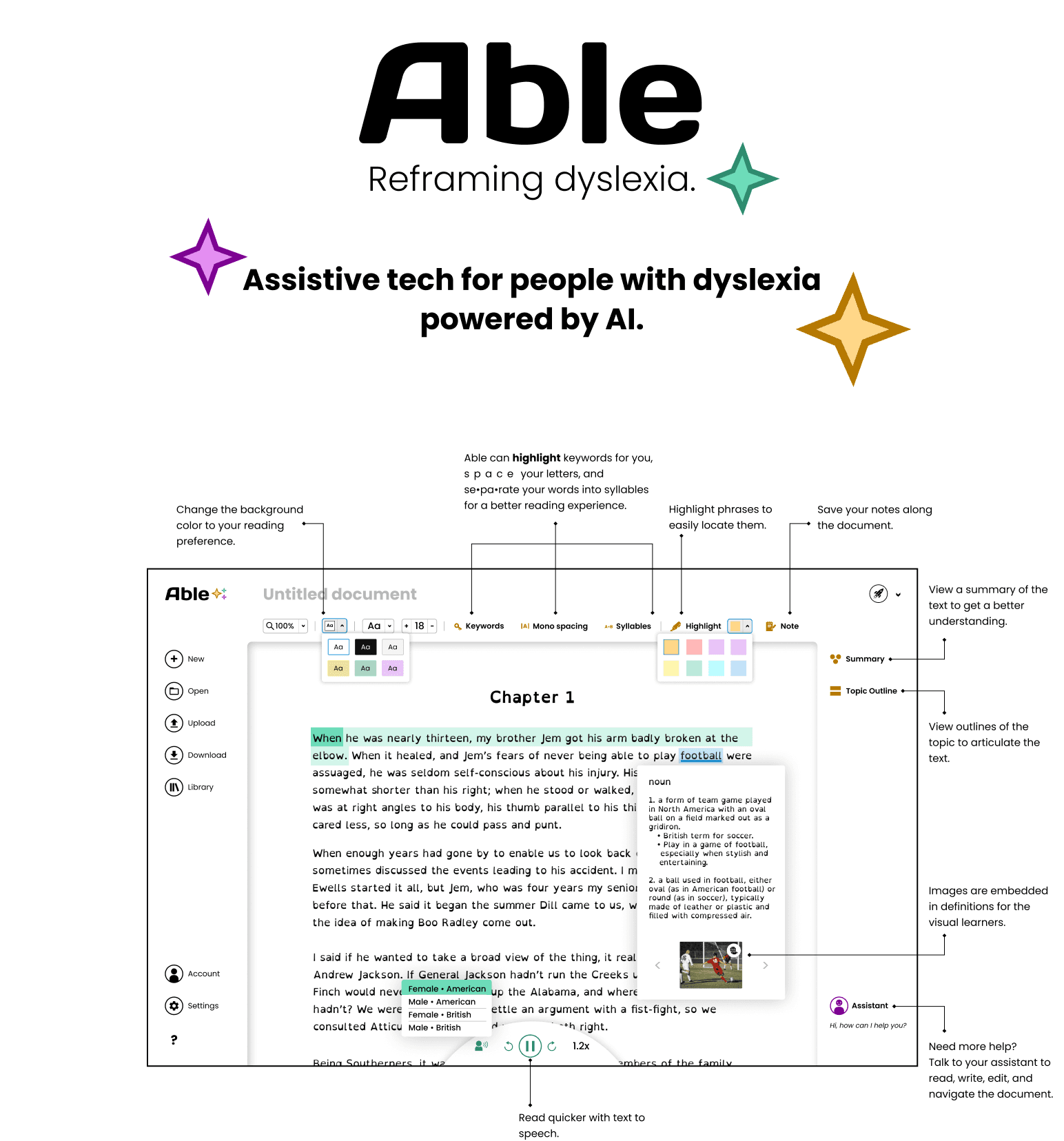
Reframing dyslexia – Assistive tech for people with dyslexia powered by AI.

Reframing dyslexia – Assistive tech for people with dyslexia powered by AI.
Reframing dyslexia – Assistive tech for people with dyslexia powered by AI.

Timeline

Sep 2022 - May 2023

Course

Thesis I + II

Professor

Aynne Valencia

Background

This Senior Project is a culmination of my personal and collaborative approach in the field of interaction design. In this project, I researched dyslexia, what services are already out there to help manage it, and finally designed and tested my product.

As someone who grew up with the struggles of dyslexia, I took the opportunity to explore new ways to facilitate these challenges with improved reading, reading comprehension, and writing.

In the ever-evolving world of technology and Artificial Intelligence, there are endless possibilities to help people in their day-to-day lives regarding accessibility, convenience, and education, to name a few.

This Senior Project is a culmination of my personal and collaborative approach in the field of interaction design. In this project, I researched dyslexia, what services are already out there to help manage it, and finally designed and tested my product.

As someone who grew up with the struggles of dyslexia, I took the opportunity to explore new ways to facilitate these challenges with improved reading, reading comprehension, and writing.

In the ever-evolving world of technology and Artificial Intelligence, there are endless possibilities to help people in their day-to-day lives regarding accessibility, convenience, and education, to name a few.

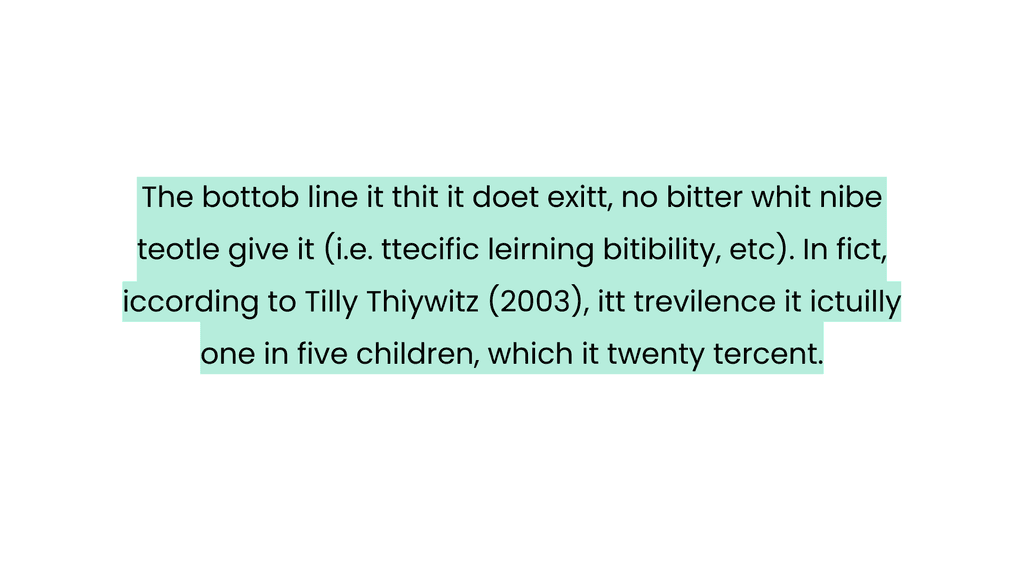
The bottob line it thit it doet exitt, no bitter whit nibe teotle give it (i.e. ttecific learning bitibility, etc). In fict, according to Tilly Thiywitz (2003), it trivelence it ictuilly one in five children, which it twenty tercent.

The bottob line it thit it doet exitt, no bitter whit nibe teotle give it (i.e. ttecific learning bitibility, etc). In fict, according to Tilly Thiywitz (2003), it trivelence it ictuilly one in five children, which it twenty tercent.

… hard to read?

… hard to read?

People with dyslexia often experience this laborious reading pace.

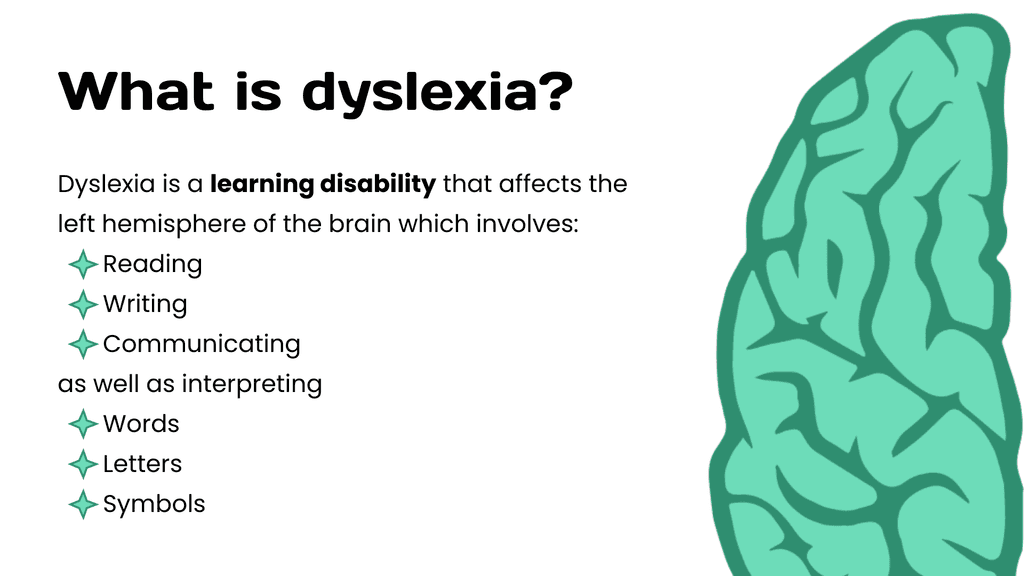
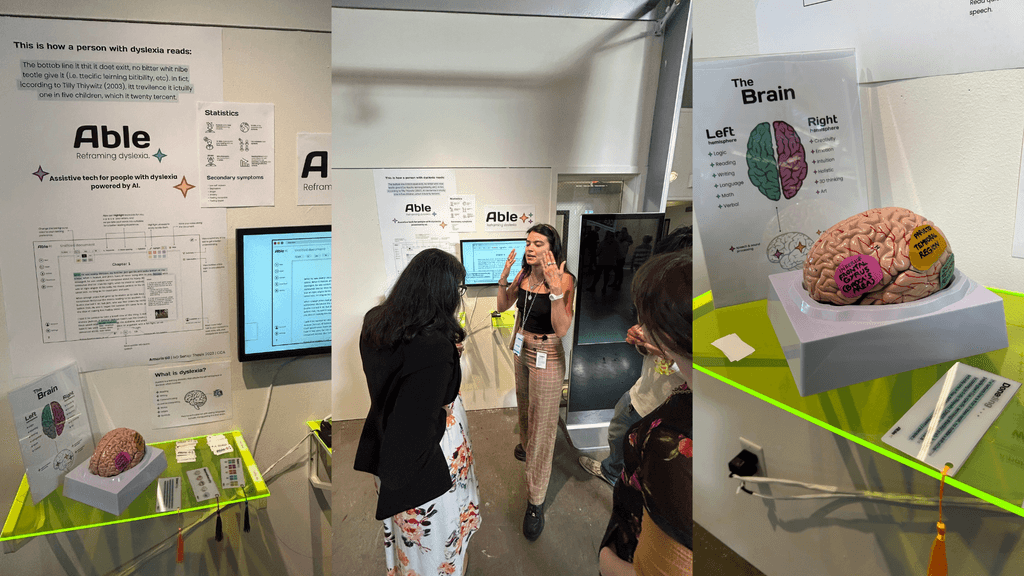
What is dyslexia?

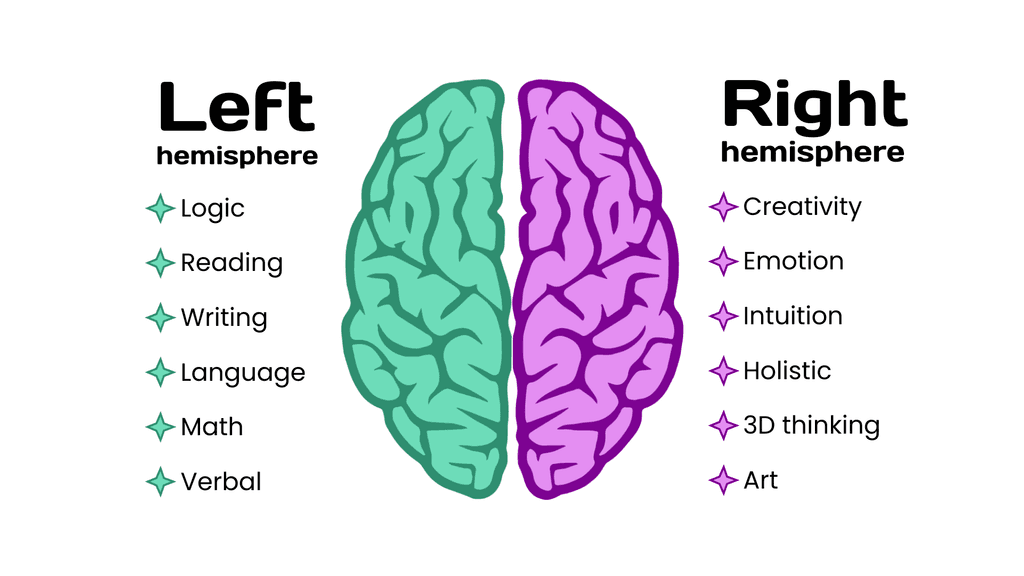
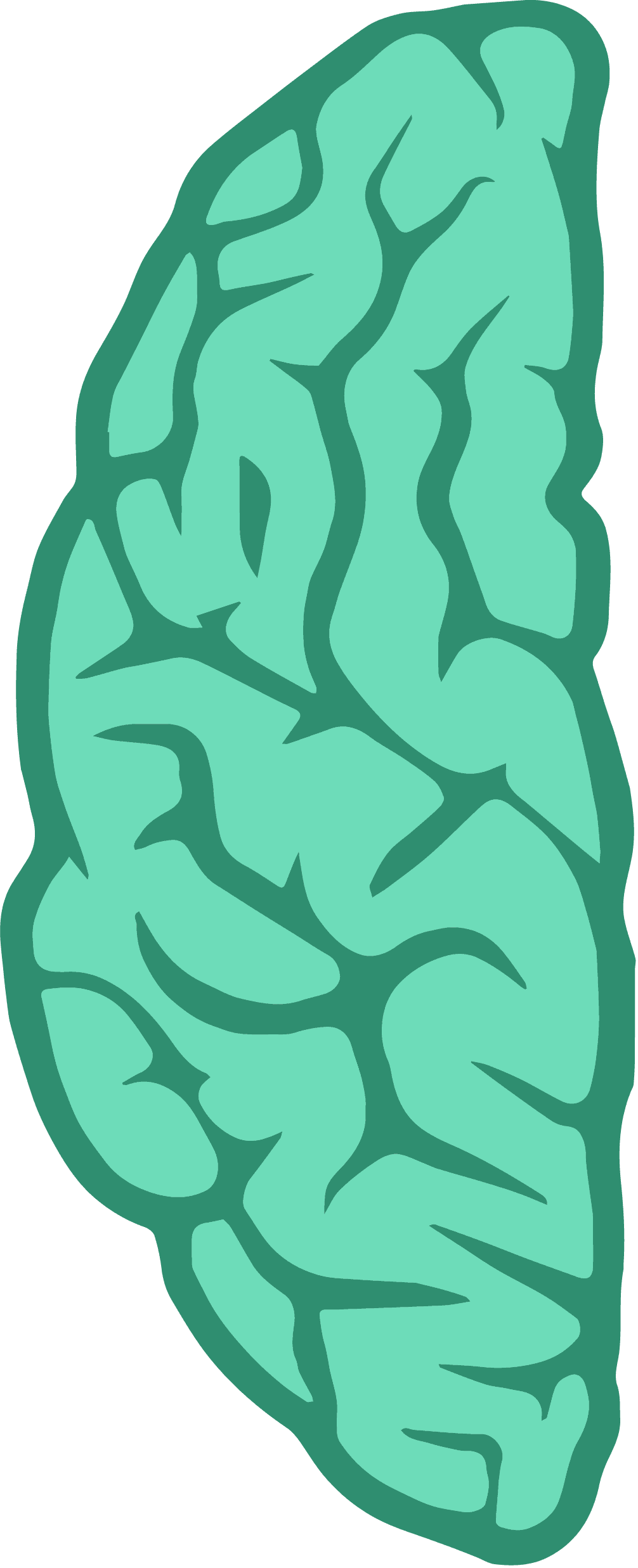
Dyslexia is a learning disability that affects the left hemisphere of the brain which is mostly responsible for:
Reading

Writing

Communicating

as well as interpreting

Words

Letters

Symbols
What is dyslexia?

Dyslexia is a learning disability that affects the left hemisphere of the brain which is mostly responsible for:

Reading

Writing

Communicating

as well as interpreting

Words

Letters

Symbols
What is dyslexia?

Dyslexia is a learning disability that affects the left hemisphere of the brain which is mostly responsible for:

Reading

Writing

Communicating

as well as interpreting

Words

Letters

Symbols
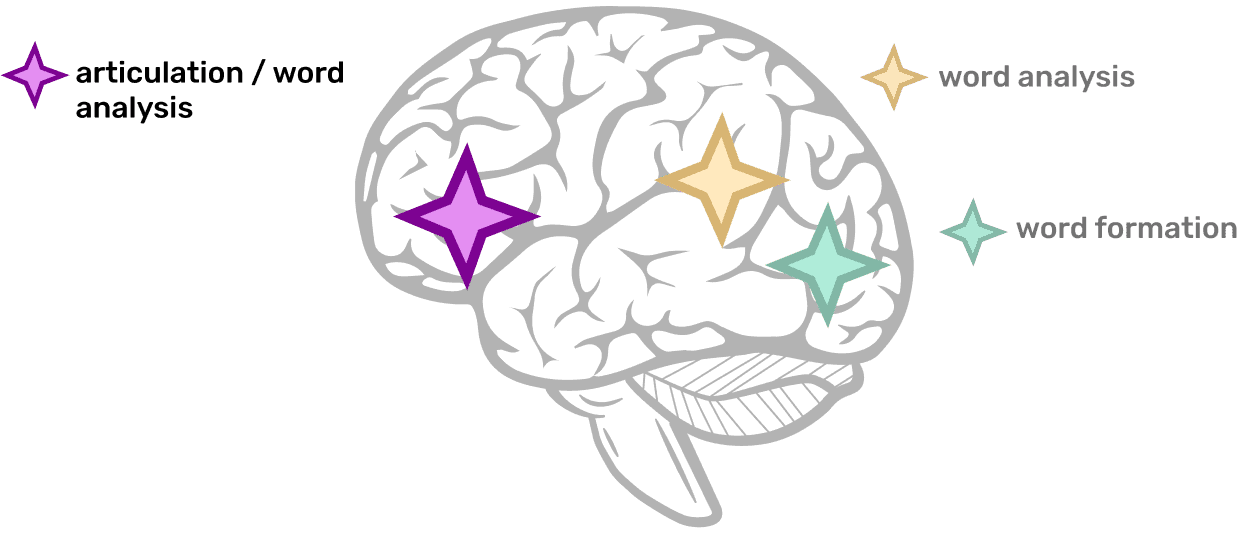
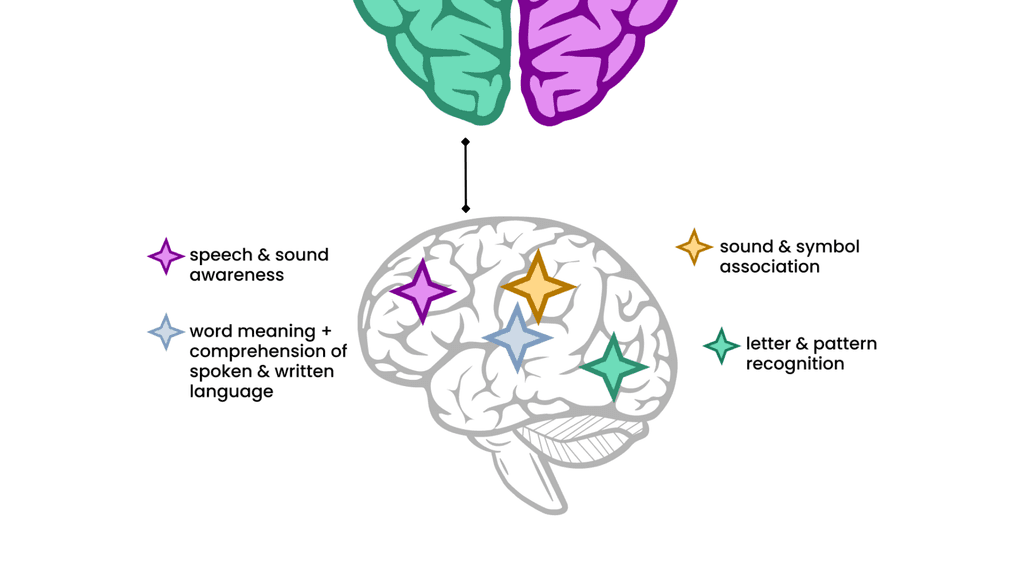
In a nutshell, a typical reader works well with all these three parts of the brain to read: the Parieto Temporal (PT) region responsible for word analysis, the Occipito Temporal (OT) region responsible for word formation, and the Inferior Frontal Gyrus (IFG) responsible for articulation/word analysis.

A dyslexic reader has issues with articulation/word analysis in the Inferior Frontal Gyrus (IFG) of the brain, or "Broca's Area".

In a nutshell, a typical reader works well with all these three parts of the brain to read: the Parieto Temporal (PT) region responsible for word analysis, the Occipito Temporal (OT) region responsible for word formation, and the Inferior Frontal Gyrus (IFG) responsible for articulation/word analysis.

A dyslexic reader has issues with articulation/word analysis in the Inferior Frontal Gyrus (IFG) of the brain, or "Broca's Area".

In a nutshell, a typical reader works well with all these three parts of the brain to read: the Parieto Temporal (PT) region responsible for word analysis, the Occipito Temporal (OT) region responsible for word formation, and the Inferior Frontal Gyrus (IFG) responsible for articulation/word analysis.

A dyslexic reader has issues with articulation/word analysis in the Inferior Frontal Gyrus (IFG) of the brain, or "Broca's Area".

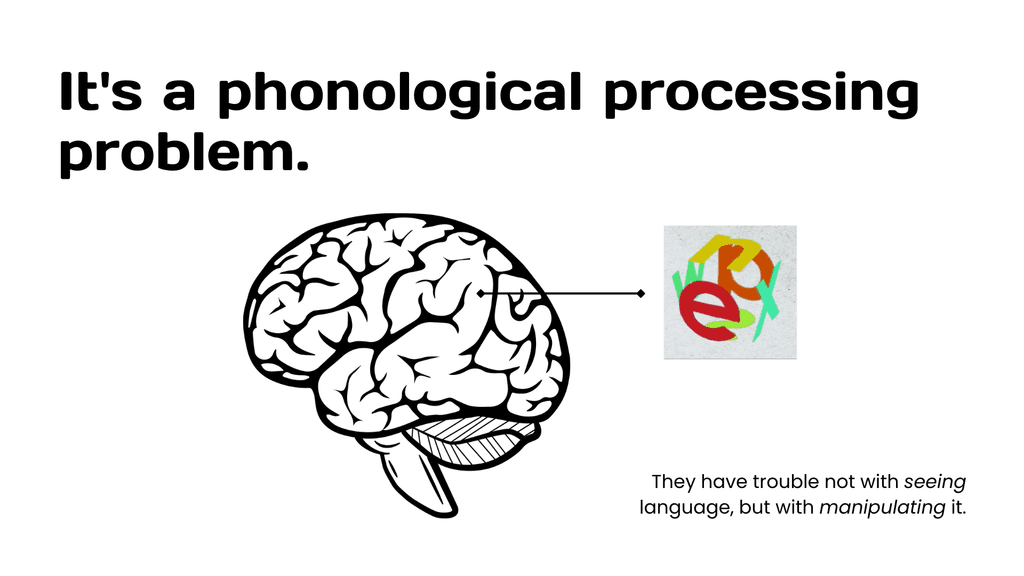
It's a phonological processing problem.
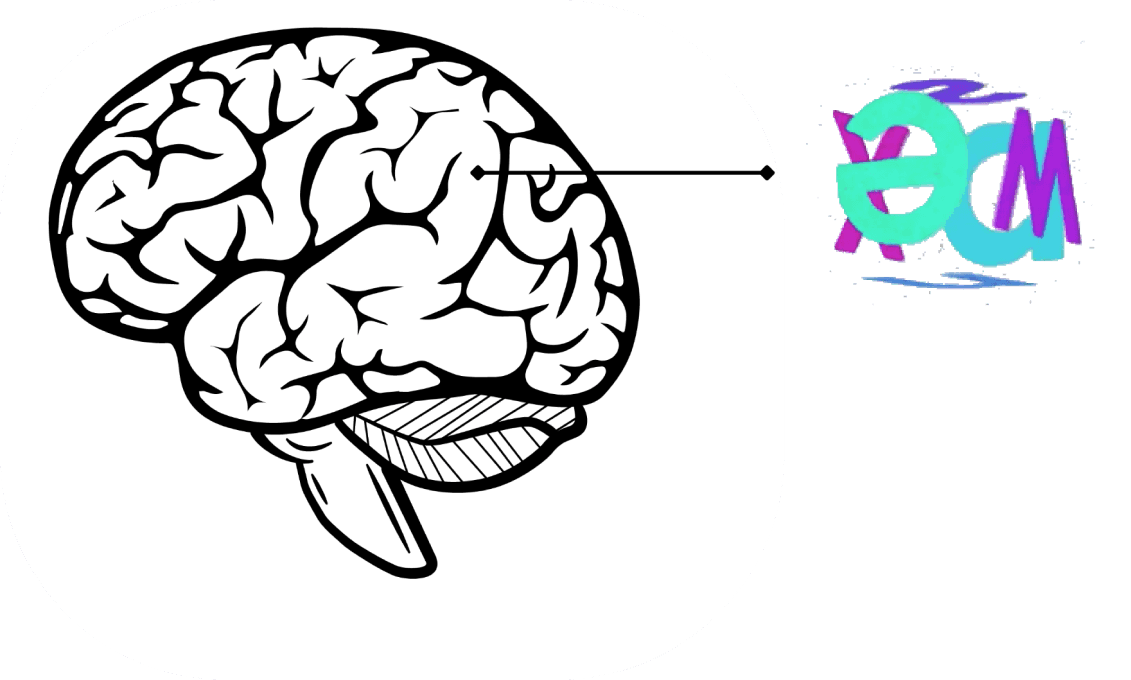
They have trouble not with seeing language, but with manipulating it.

It's a phonological processing problem.

They have trouble not with seeing language, but with manipulating it.

It's a phonological processing problem.

They have trouble not with seeing language, but with manipulating it.

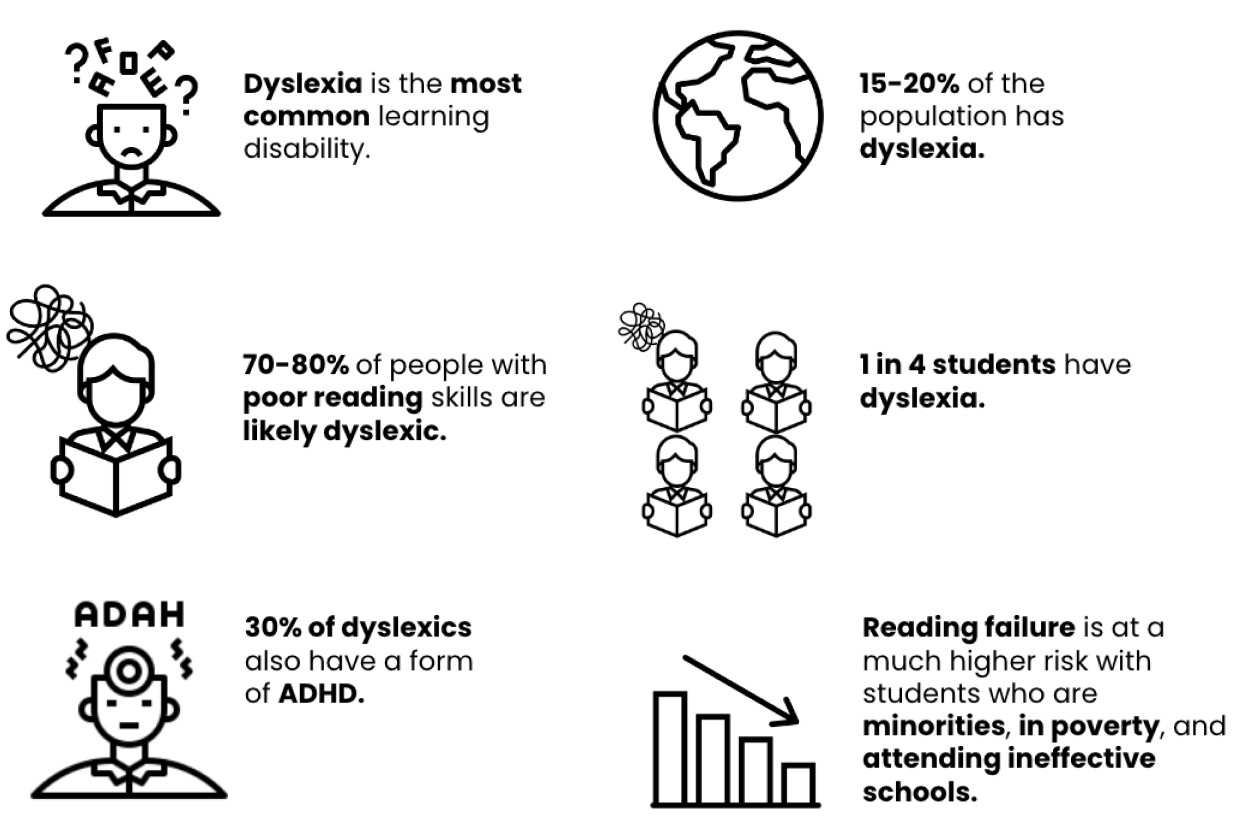
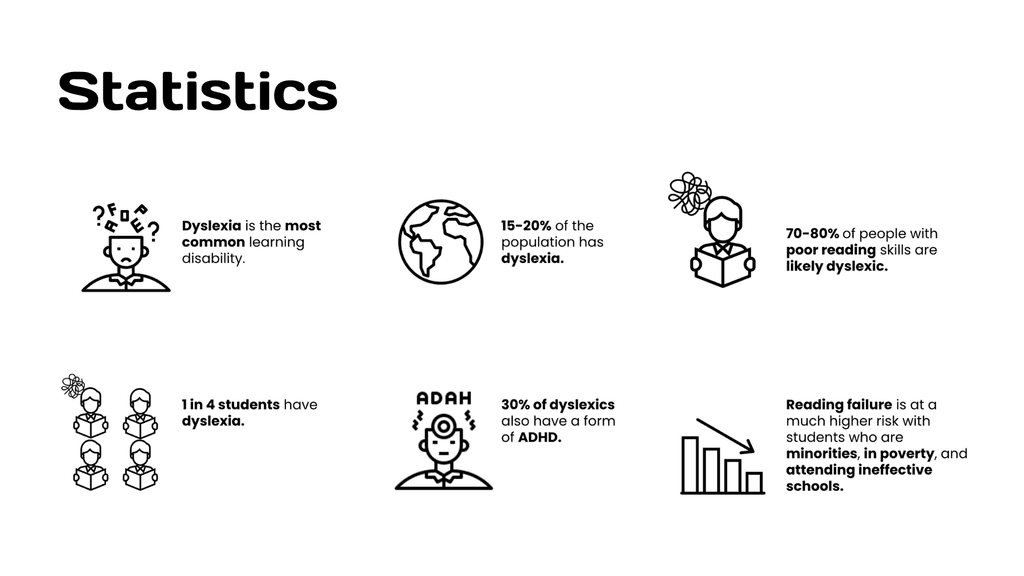
Statistics
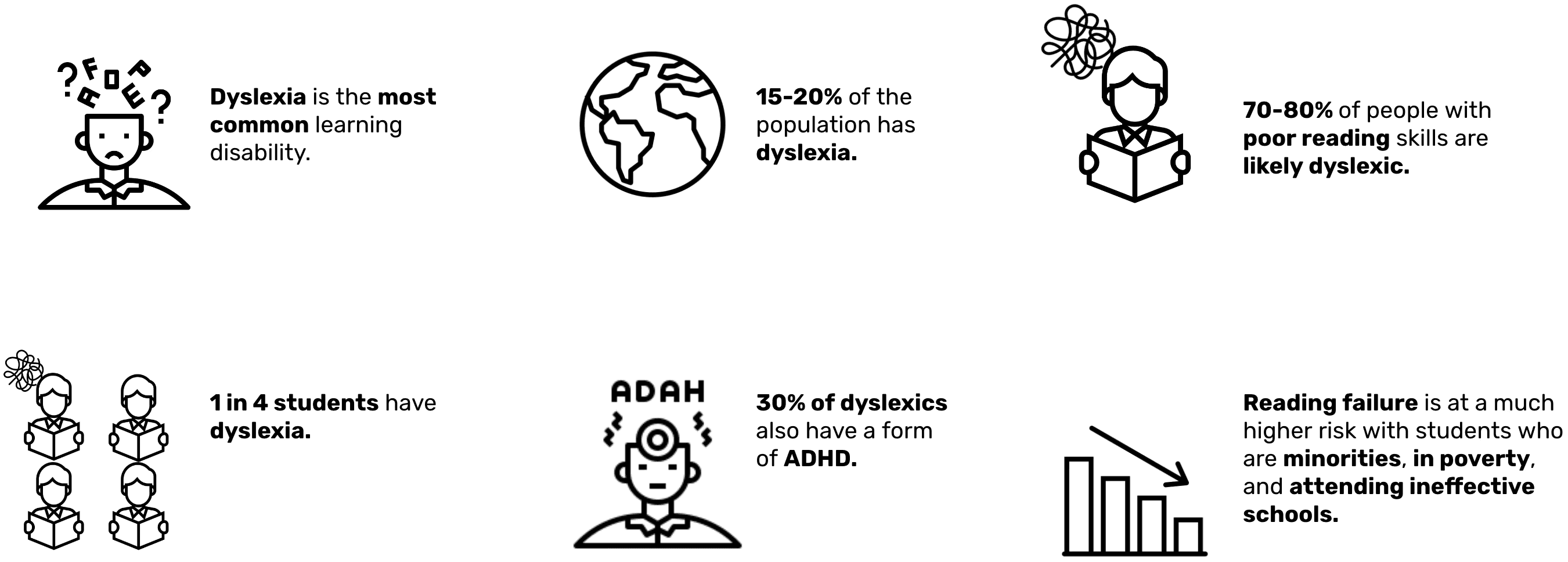
Secondary symptoms

  • Low self-esteem

  • Depression

  • Anger

  • Anxiety

  • Feeling incapable

  • Feeling stupid

Statistics

Secondary symptoms

  • Low self-esteem

  • Depression

  • Anger

  • Anxiety

  • Feeling incapable

  • Feeling stupid

Statistics

Secondary symptoms

  • Low self-esteem

  • Depression

  • Anger

  • Anxiety

  • Feeling incapable

  • Feeling stupid

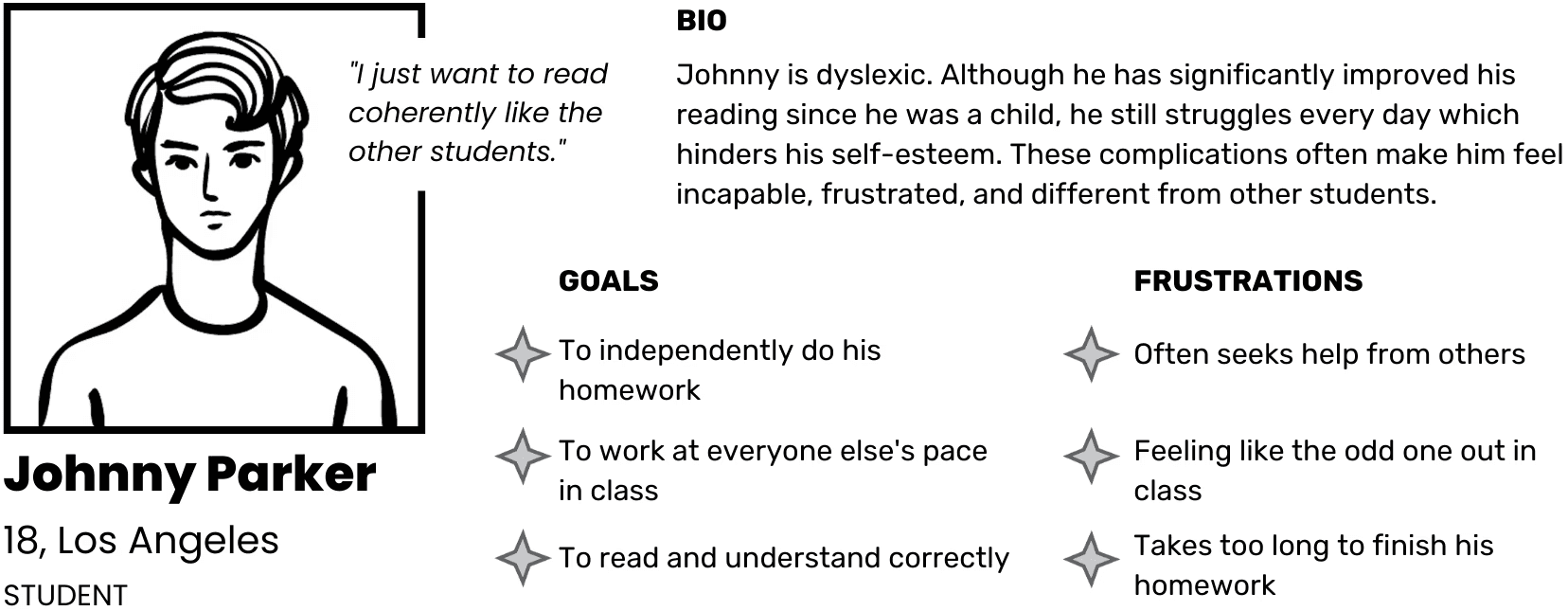
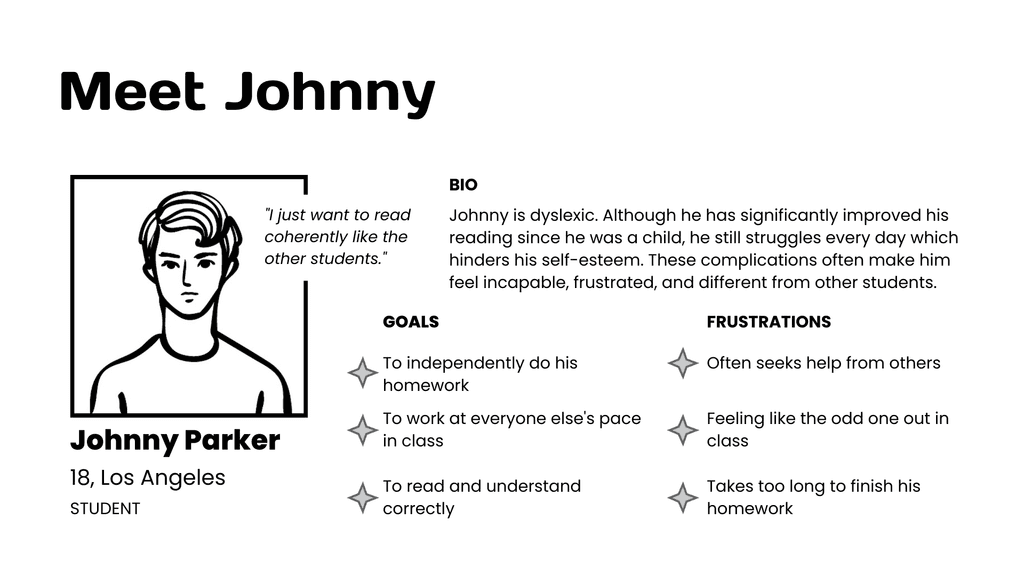
Meet Johnny

Meet Johnny
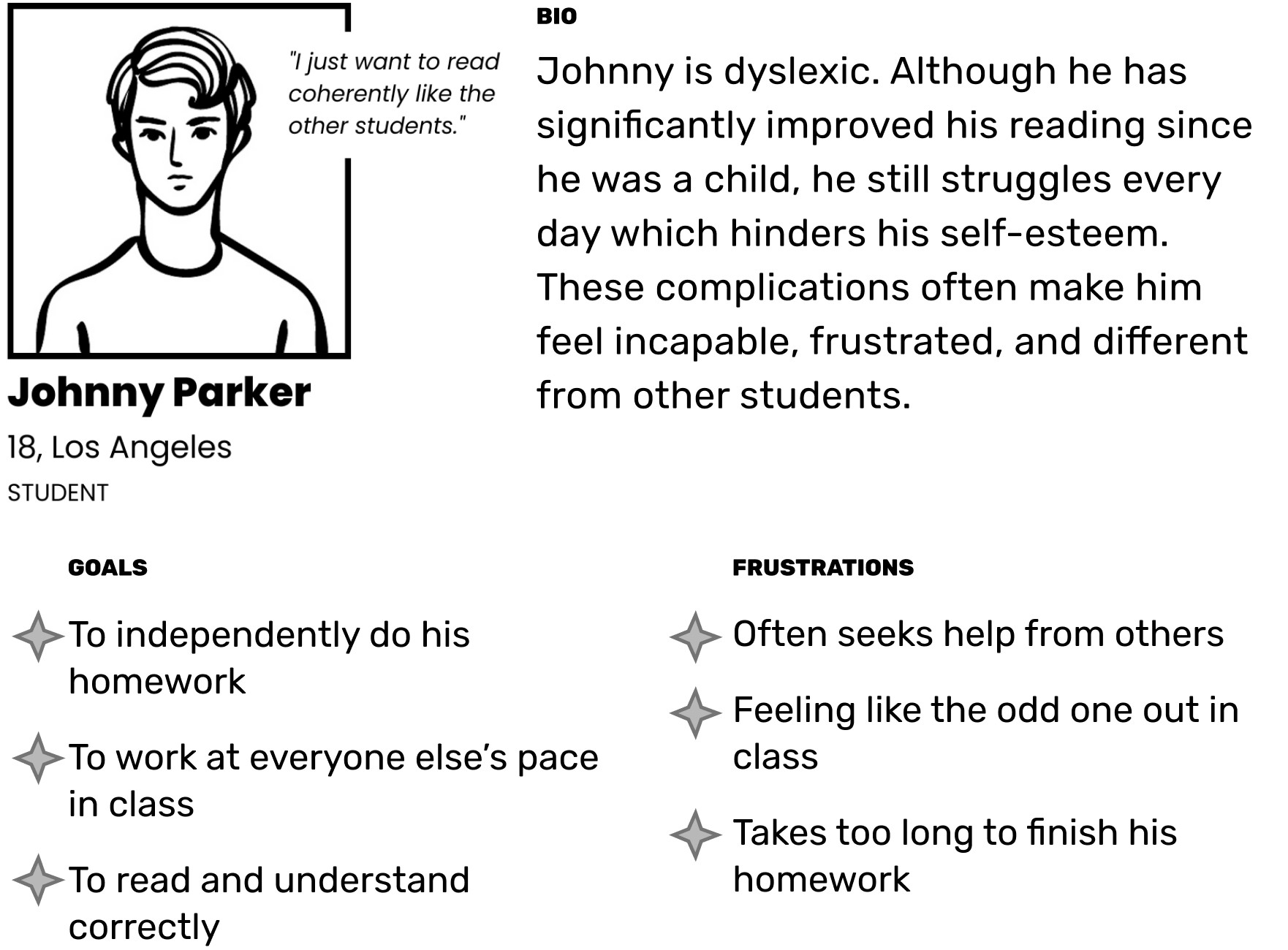
Meet Johnny
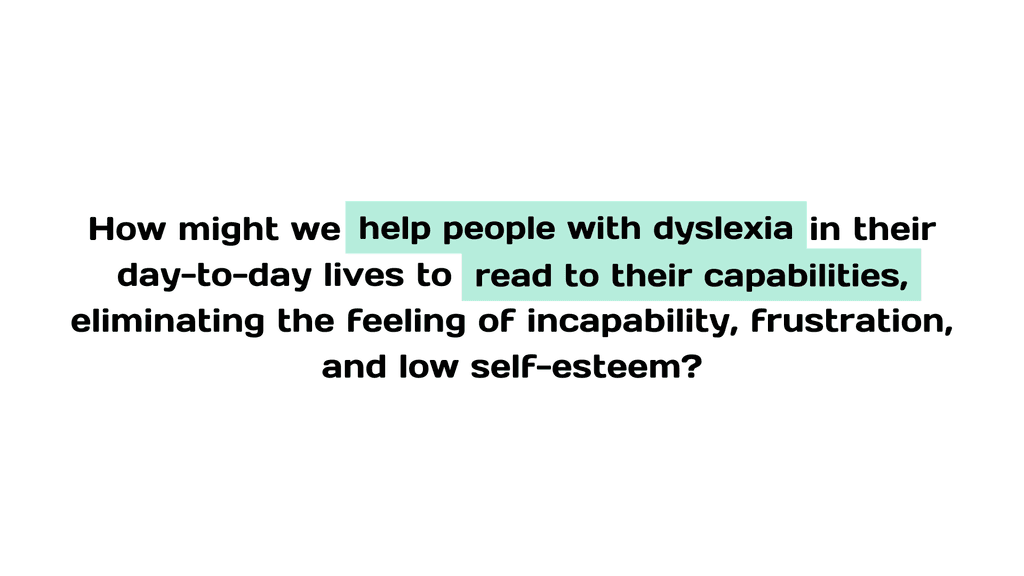
How might we help people with dyslexia in their day-to-day lives to read to their capabilities, eliminating the feeling of incapability, frustration, and low self-esteem?

How might we help people with dyslexia in their day-to-day lives to read to their capabilities, eliminating the feeling of incapability, frustration, and low self-esteem?

Design Process

1

Concept Mapping

1

Concept Mapping

5

Style Guide

5

Style Guide

2

Personal Manifesto

2

Personal Manifesto

6

User Testing

6

User Testing

3

Literature Review

3

Literature Review

7

Final Presentation

7

Final Presentation

4

Opportunity Analysis

4

Opportunity Analysis

1

Concept Mapping

1

Concept Mapping

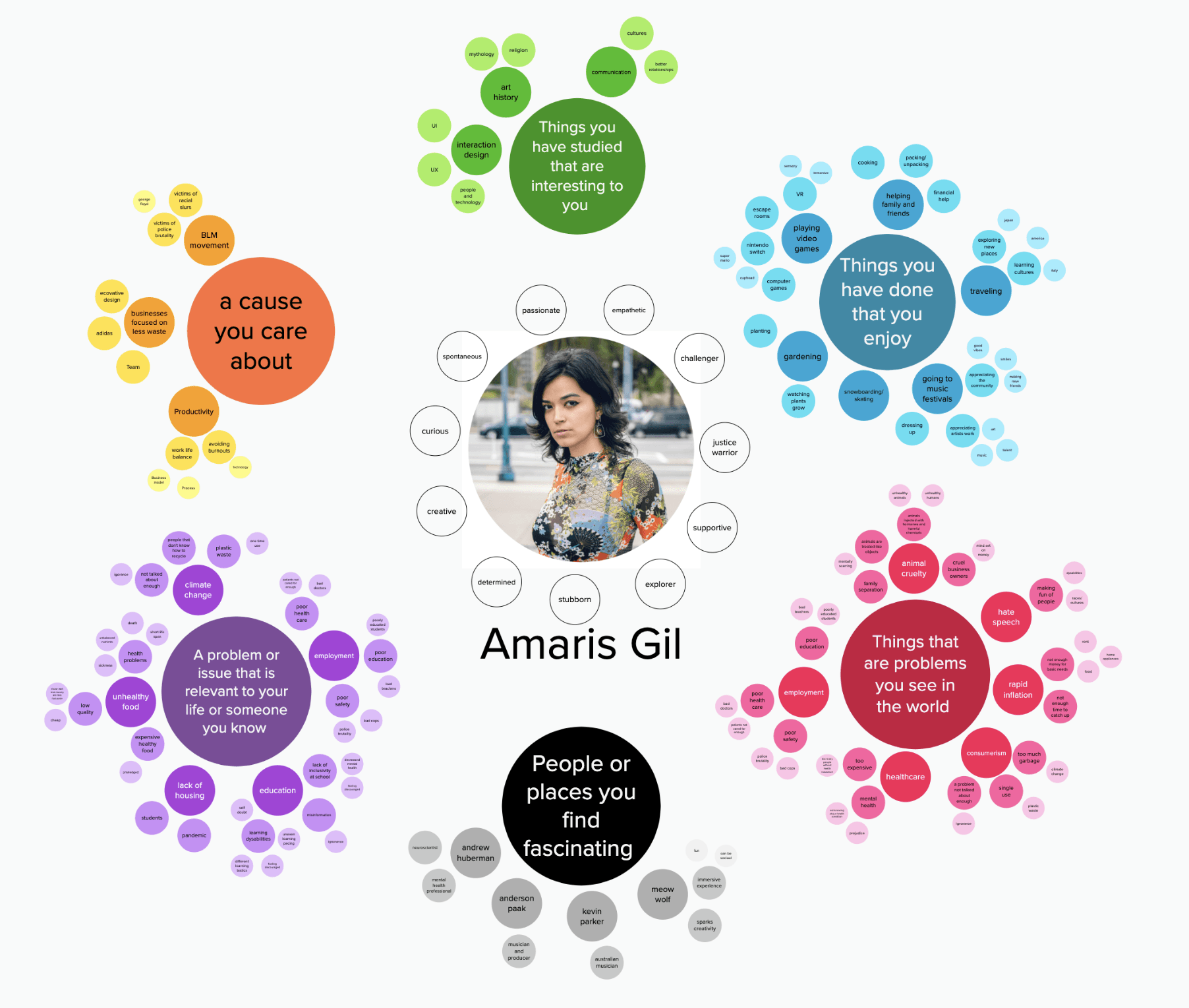
The first week I explored who I am as a person. I answered questions in Mural, an online platform that enables innovative teams to think and collaborate visually to solve problems, such as:

  • What causes do I care about?

  • What problems or issues are relevant to my life or someone I know?

  • What places or people do I find fascinating?

  • What problems do I see in the world?

  • What are some things that I have done that I enjoy?

  • What things have I studied that are interesting?

After answering these questions we collectively shared with the class and picked our favorite concepts to design.

The first week I explored who I am as a person. I answered questions in Mural, an online platform that enables innovative teams to think and collaborate visually to solve problems, such as:

  • What causes do I care about?

  • What problems or issues are relevant to my life or someone I know?

  • What places or people do I find fascinating?

  • What problems do I see in the world?

  • What are some things that I have done that I enjoy?

  • What things have I studied that are interesting?

After answering these questions we collectively shared with the class and picked our favorite concepts to design.

2

Personal Manifesto

2

Personal Manifesto

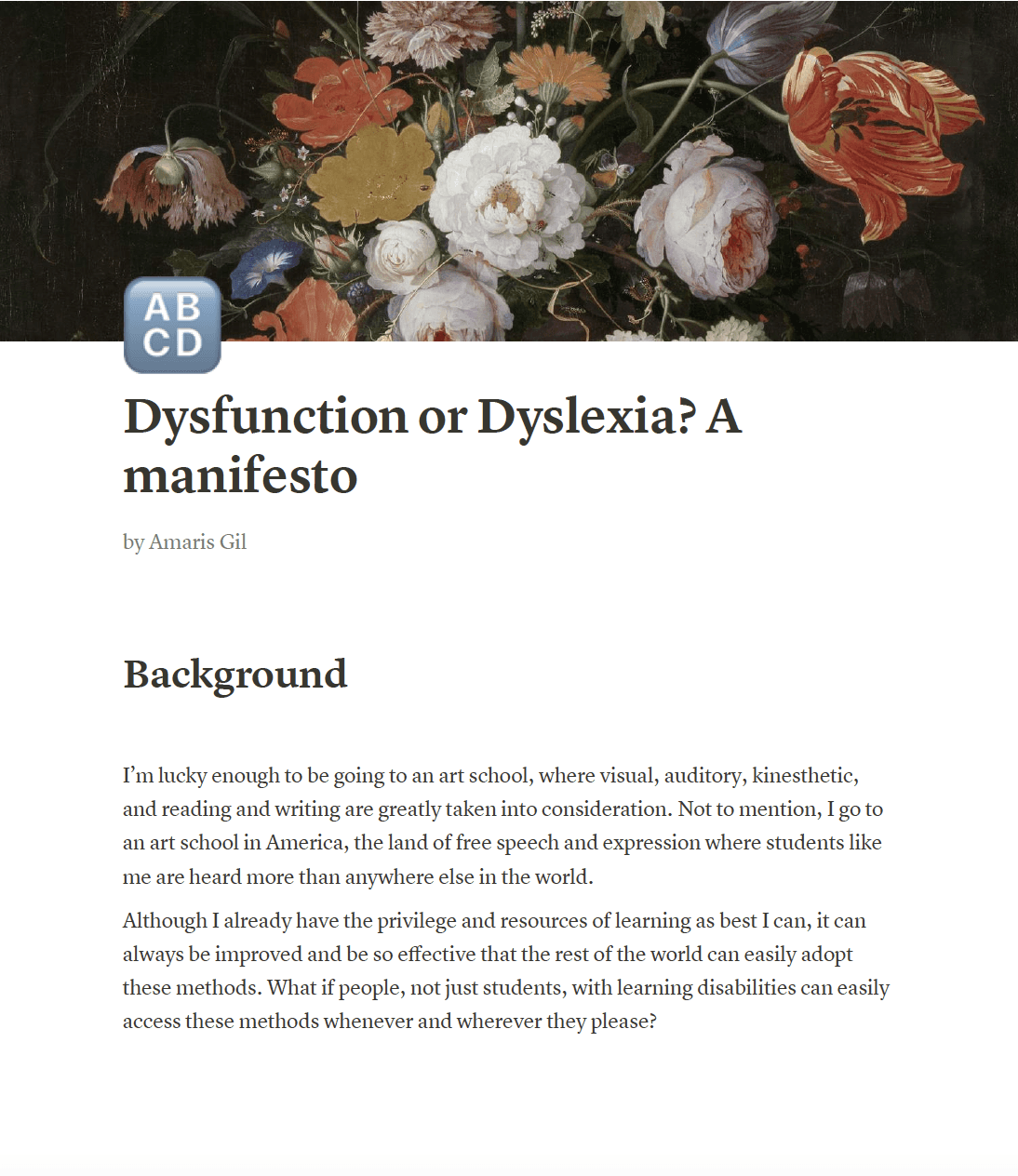
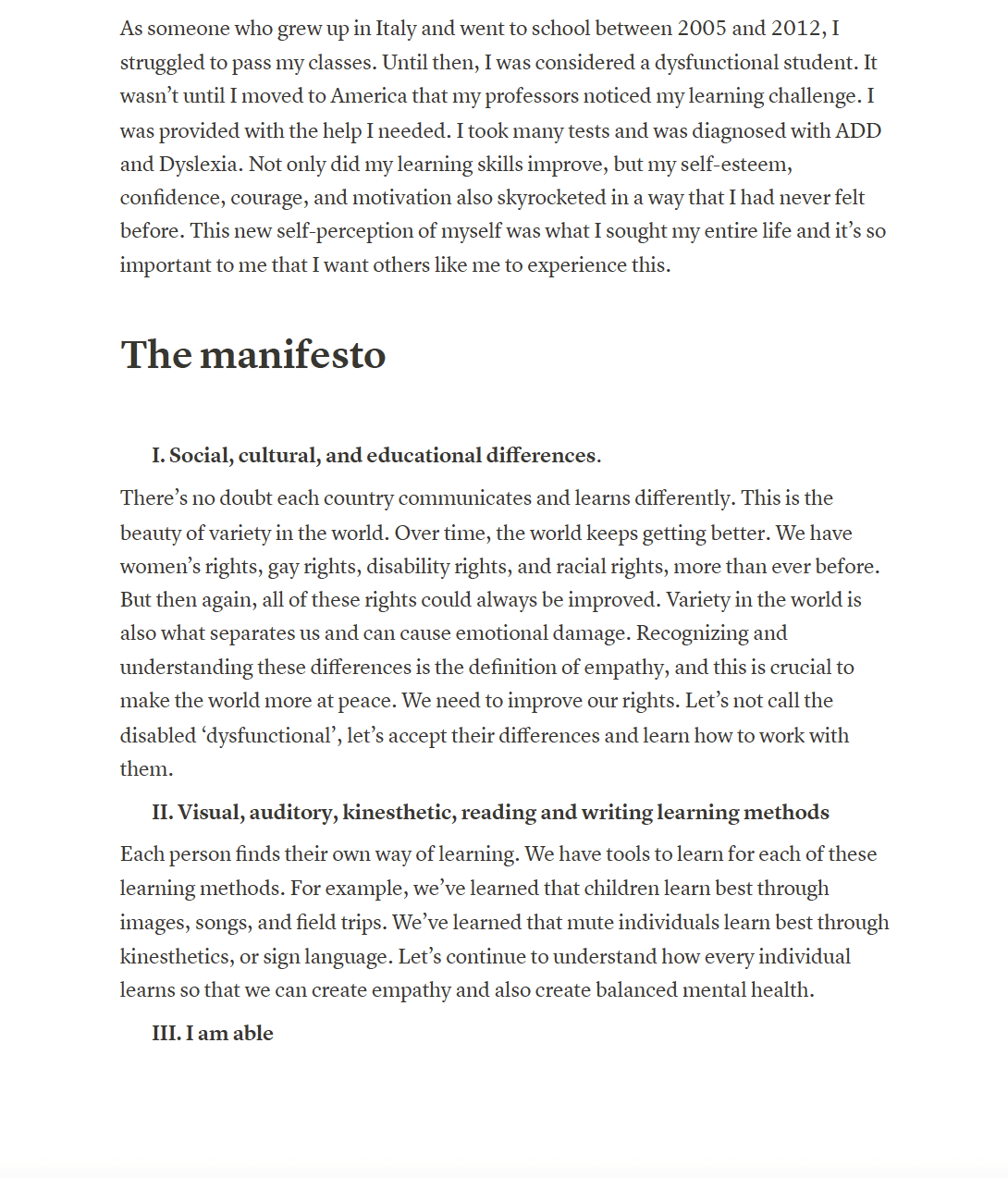
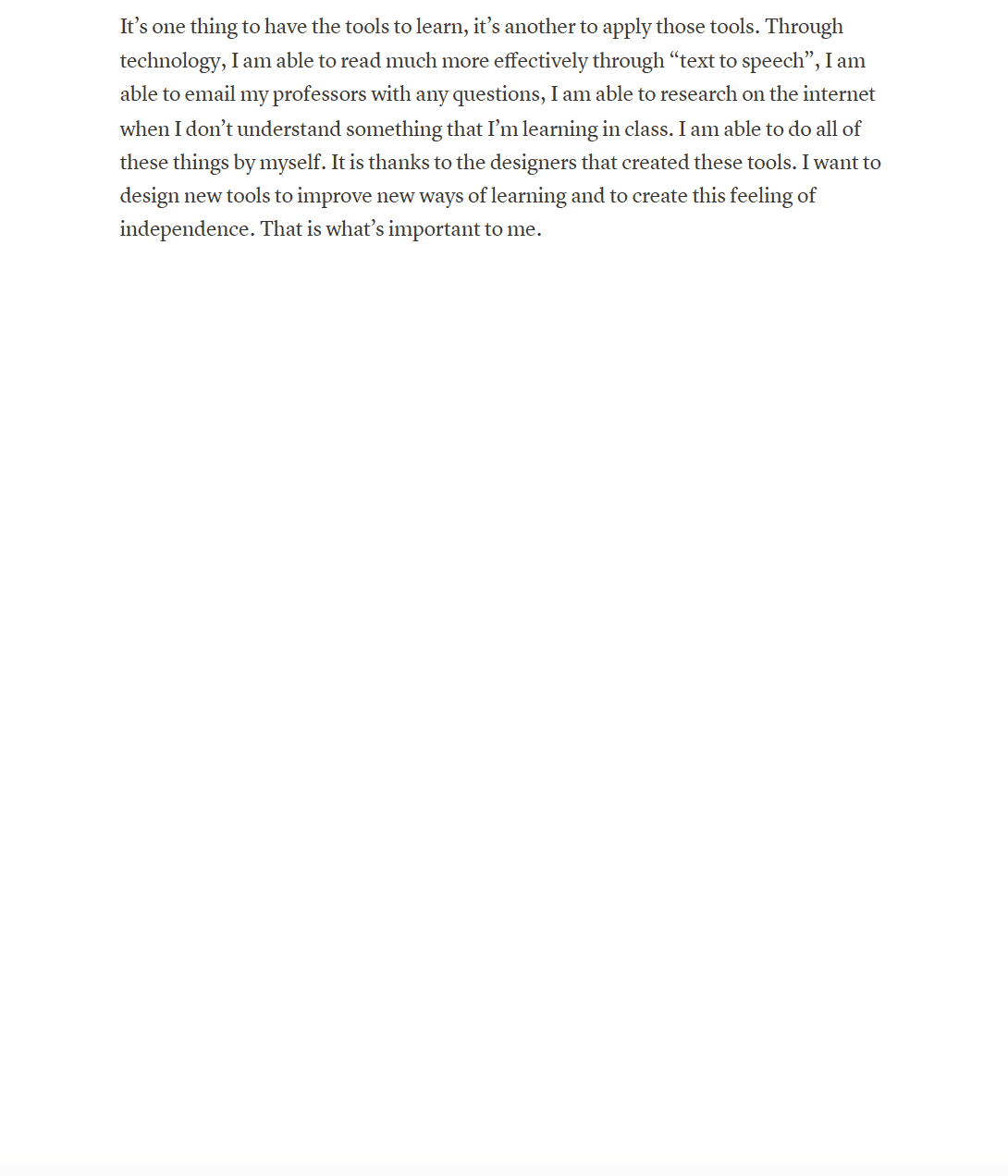
After exploring who I am as a person, I found that I'm most passionate about helping people with dyslexia, a Neurodevelopmental Disorder I've struggled with my entire life. I created a "manifesto" which is a public declaration of intentions, opinions, or motives, as one issued by a government, jurisdiction, or organization that describes what I care about.​

This manifesto is about my experience as a dyslexic student in America after moving from Italy, a country where neurological disabilities weren't taken as seriously in my experience. 

After exploring who I am as a person, I found that I'm most passionate about helping people with dyslexia, a Neurodevelopmental Disorder I've struggled with my entire life. I created a "manifesto" which is a public declaration of intentions, opinions, or motives, as one issued by a government, jurisdiction, or organization that describes what I care about.​

This manifesto is about my experience as a dyslexic student in America after moving from Italy, a country where neurological disabilities weren't taken as seriously in my experience. 

The manifesto helped me to freely express my emotions on dyslexia and to make a statement on why I care so much about it. 

The manifesto helped me to freely express my emotions on dyslexia and to make a statement on why I care so much about it. 

3

Literature Review

3

Literature Review

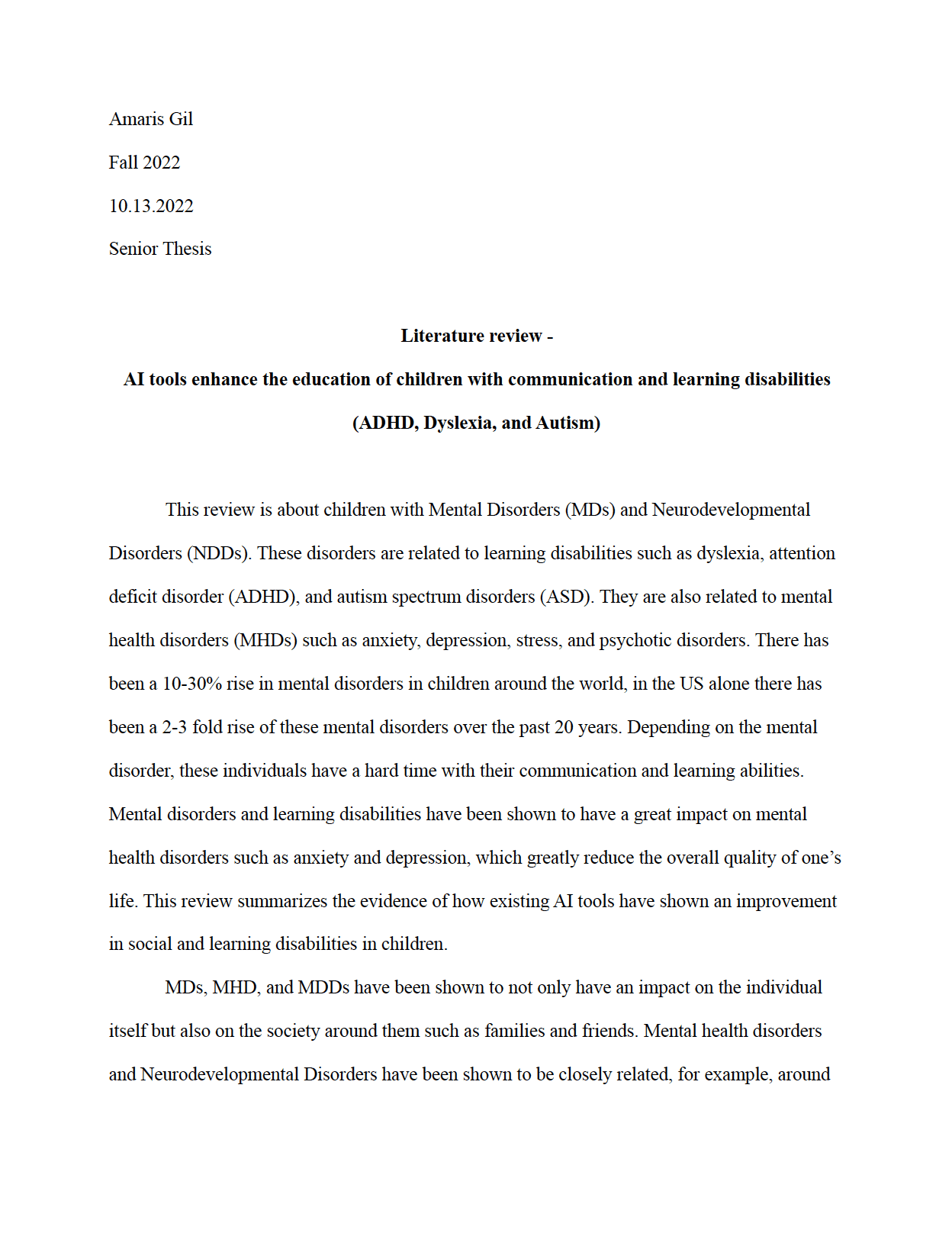
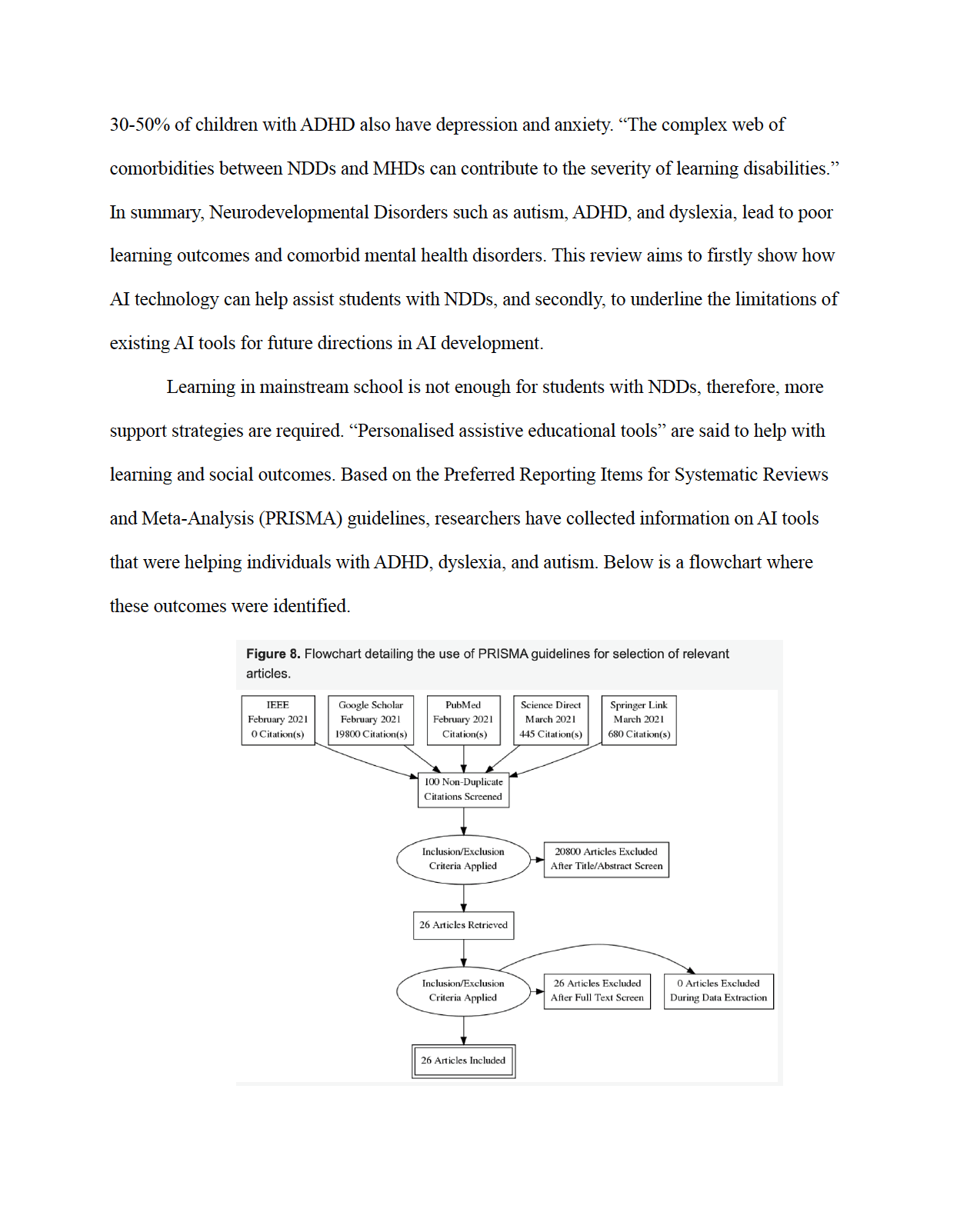
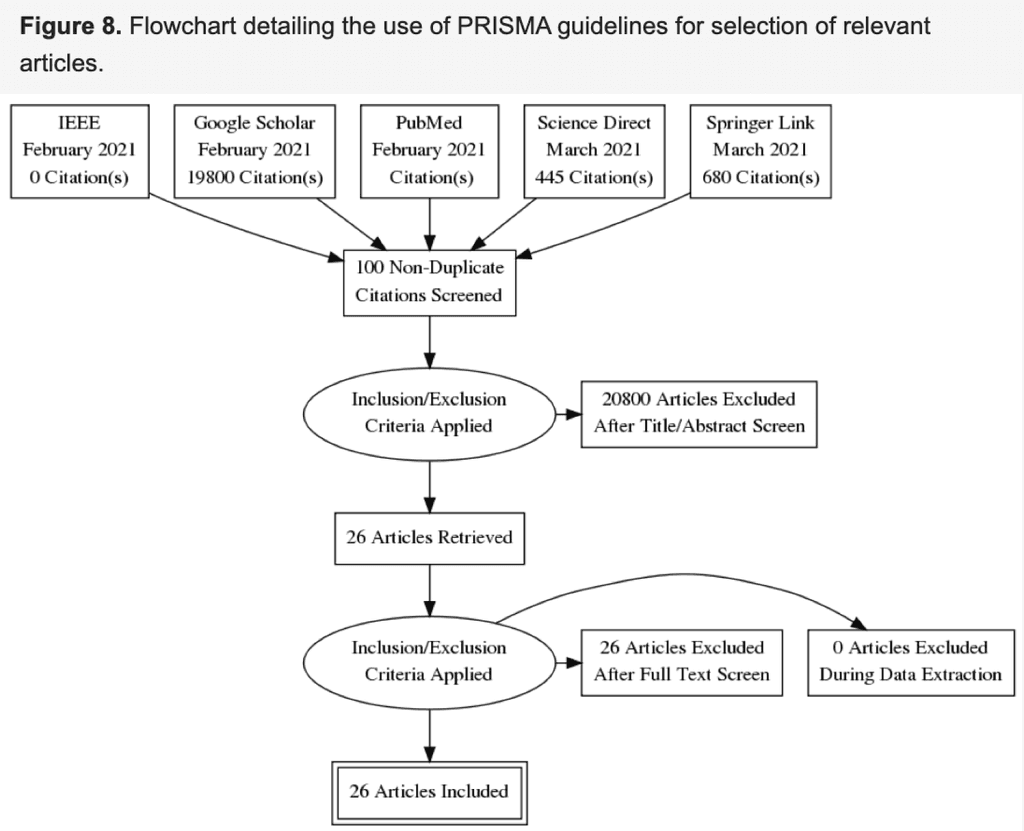
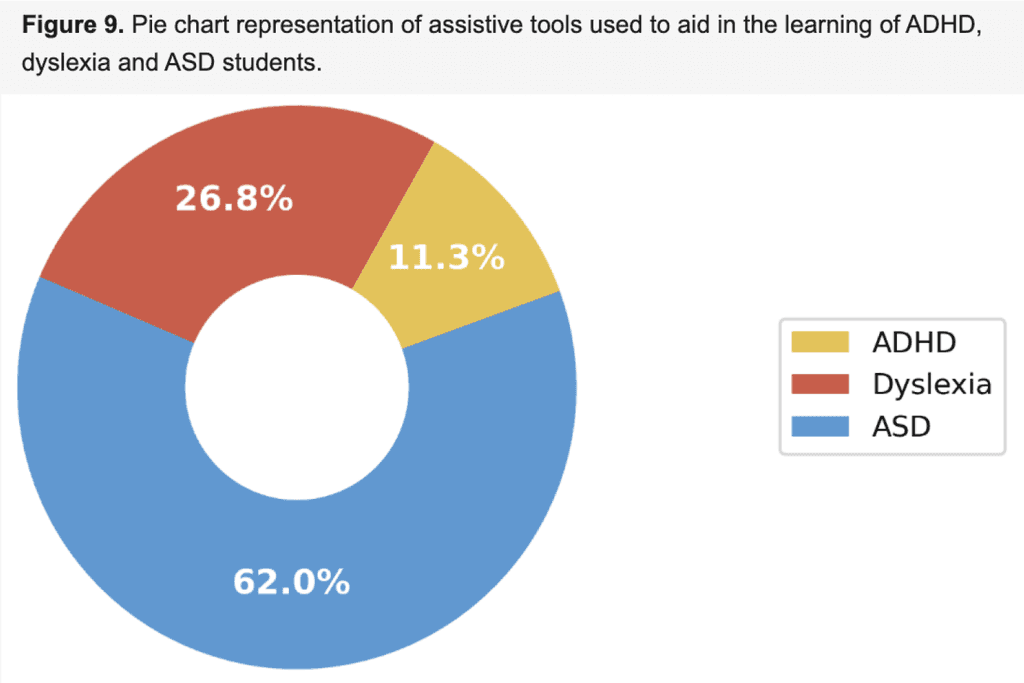
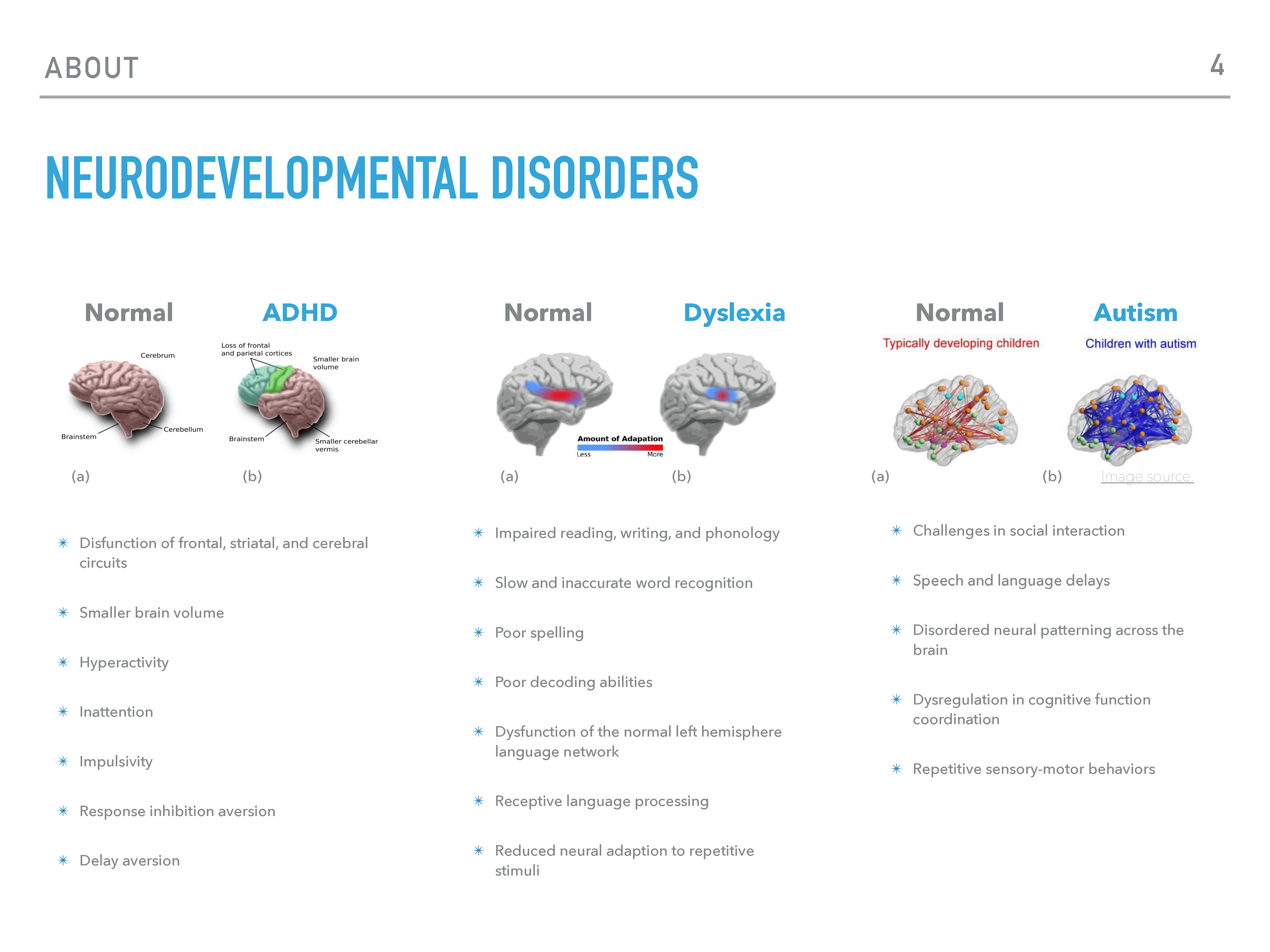
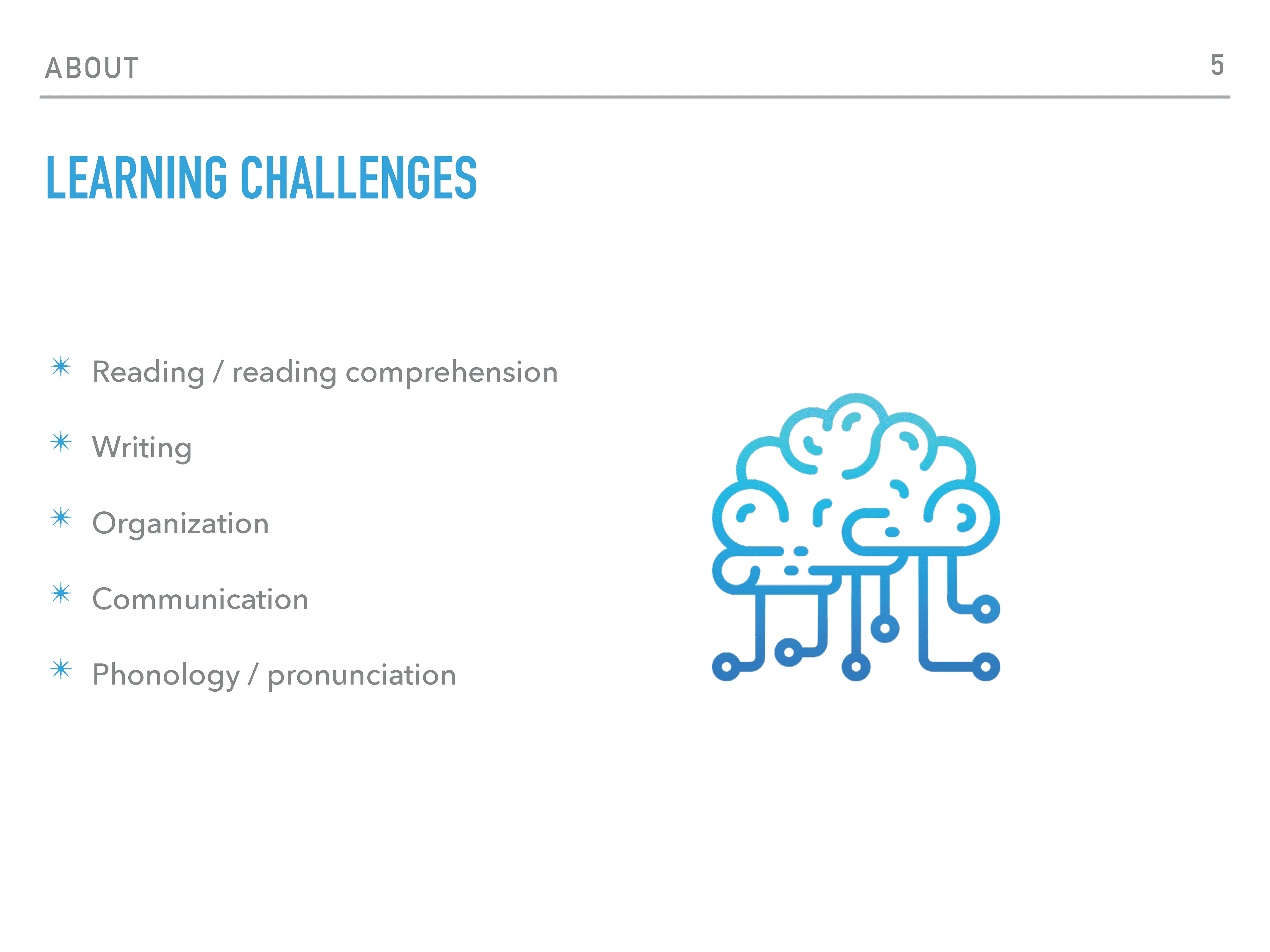
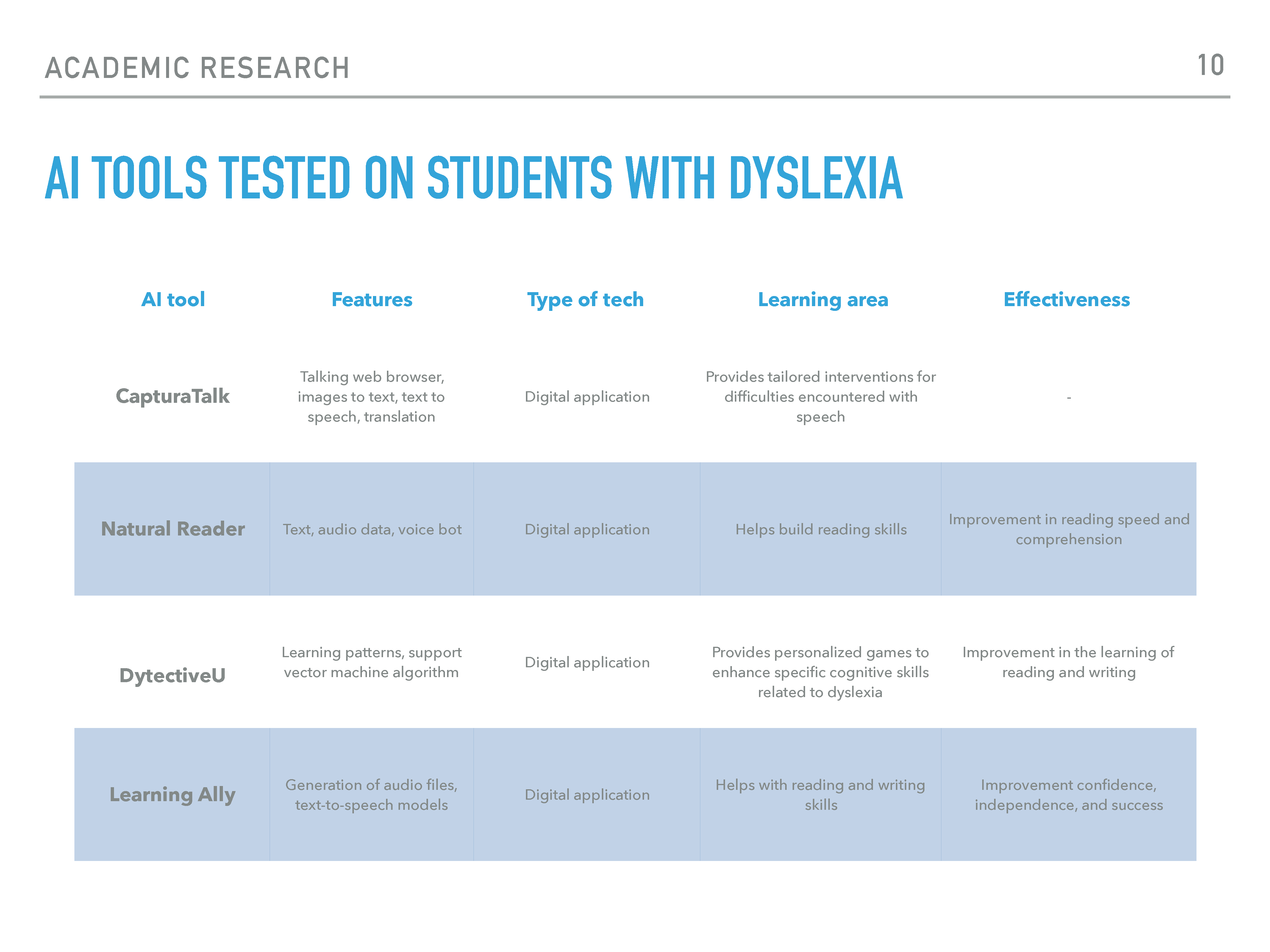
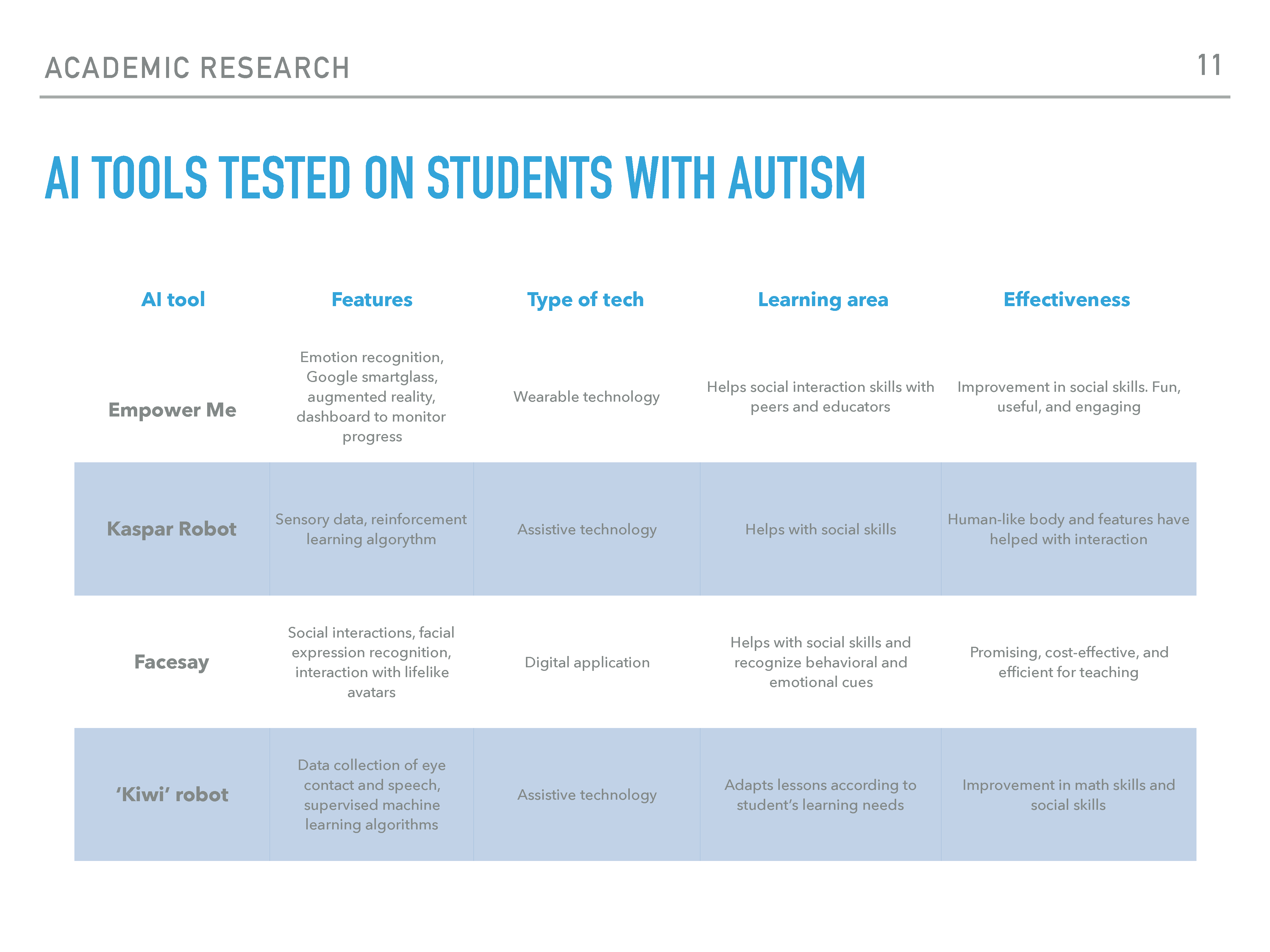
In this literature review I explored ​how AI tools enhance the education of children with communication and learning disabilities of three common Neurodevelopmental Disorders (NDDs) including dyslexia, ADHD, and autism. Doing a literature review is important to discover what's already known about the topic and how other researchers have approached it.

At this point in the project, I decided to expand my target audience to these three Neurodevelopmental Disorders (NDDs) because they commonly have learning disabilities and difficulty with communication, as well as Mental health Disorders (MDs) such as depression, anxiety, stress, and psychotic disorders.

In this literature review I explored ​how AI tools enhance the education of children with communication and learning disabilities of three common Neurodevelopmental Disorders (NDDs) including dyslexia, ADHD, and autism. Doing a literature review is important to discover what's already known about the topic and how other researchers have approached it.

At this point in the project, I decided to expand my target audience to these three Neurodevelopmental Disorders (NDDs) because they commonly have learning disabilities and difficulty with communication, as well as Mental health Disorders (MDs) such as depression, anxiety, stress, and psychotic disorders.

Key Findings

Key Findings

  • Over the past 20 years there has been a 10-30% rise in mental disorders around the world

  • In the US alone there has been a 2-3 fold rise in these mental disorders

  • Neurodevelopmental Disorders lead to poor learning outcomes and comorbid mental disorders

  • 30-50% of children with ADHD also have depression and anxiety

  • Personalized assistive educational tools, such as cloud computing, are said to help with learning and social outcomes​

  • Over the past 20 years there has been a 10-30% rise in mental disorders around the world

  • In the US alone there has been a 2-3 fold rise in these mental disorders

  • Neurodevelopmental Disorders lead to poor learning outcomes and comorbid mental disorders

  • 30-50% of children with ADHD also have depression and anxiety

  • Personalized assistive educational tools, such as cloud computing, are said to help with learning and social outcomes​

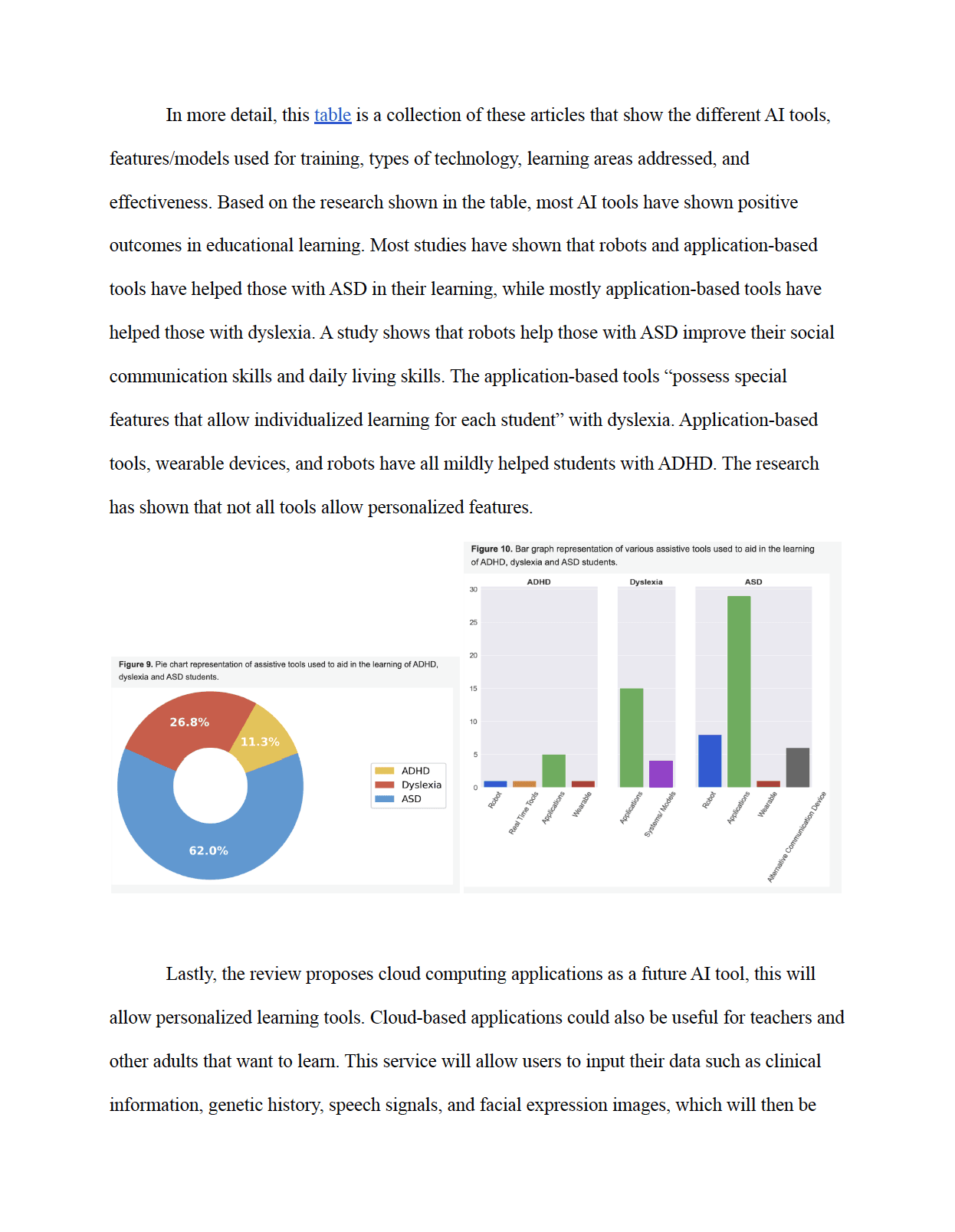
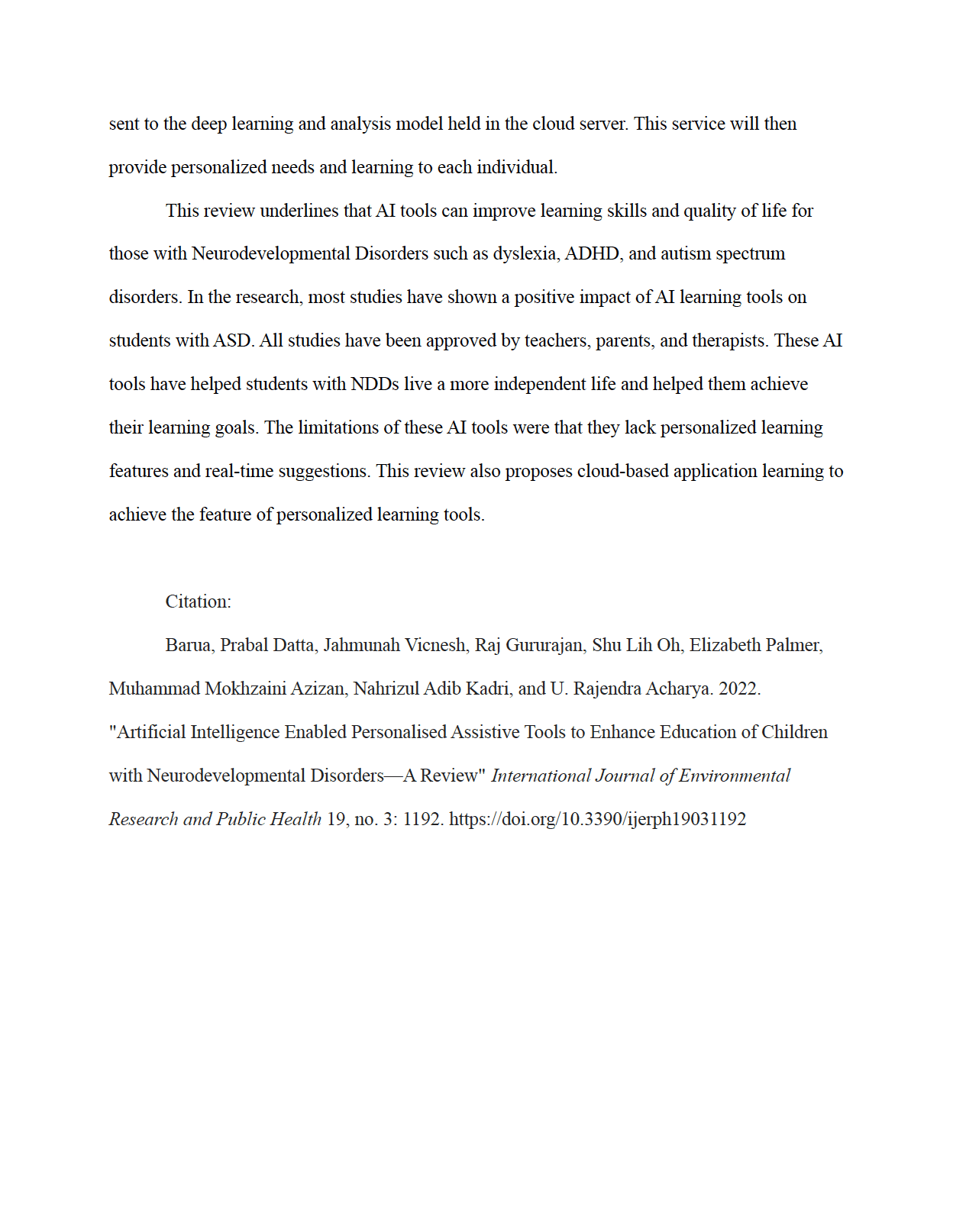
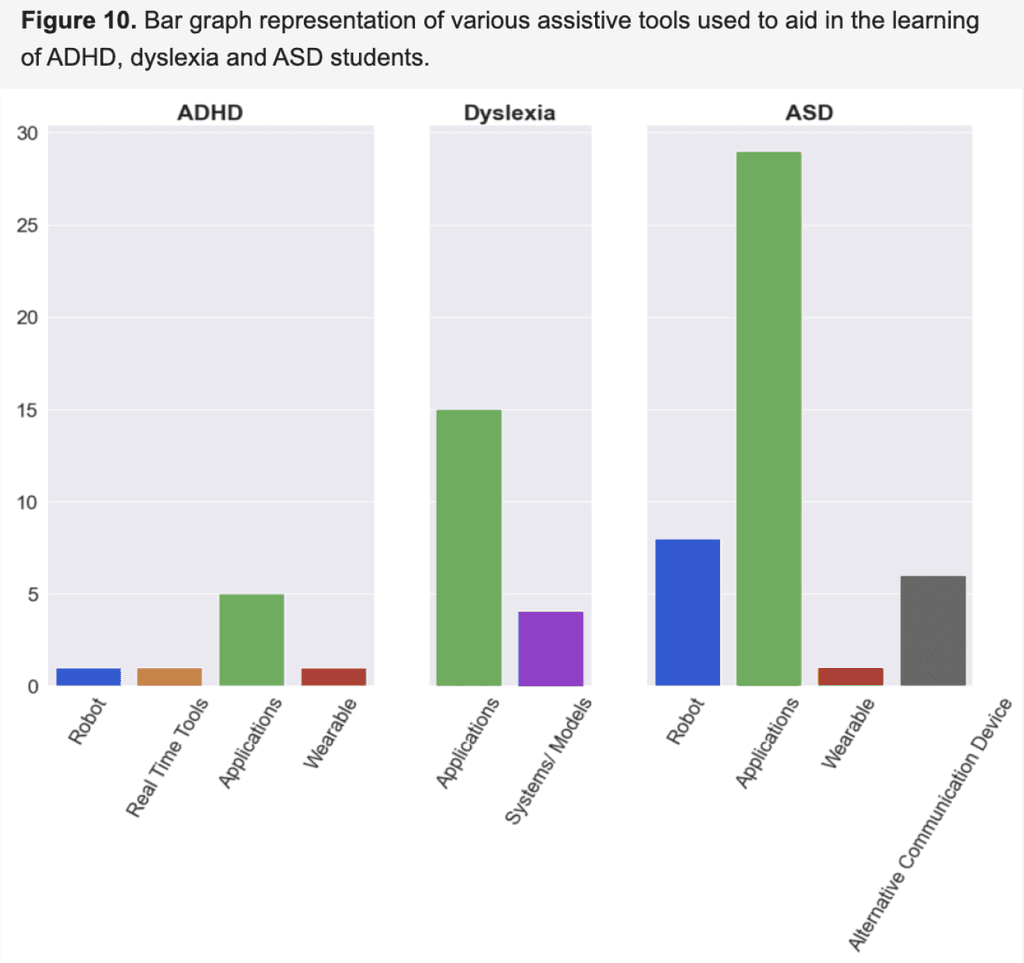
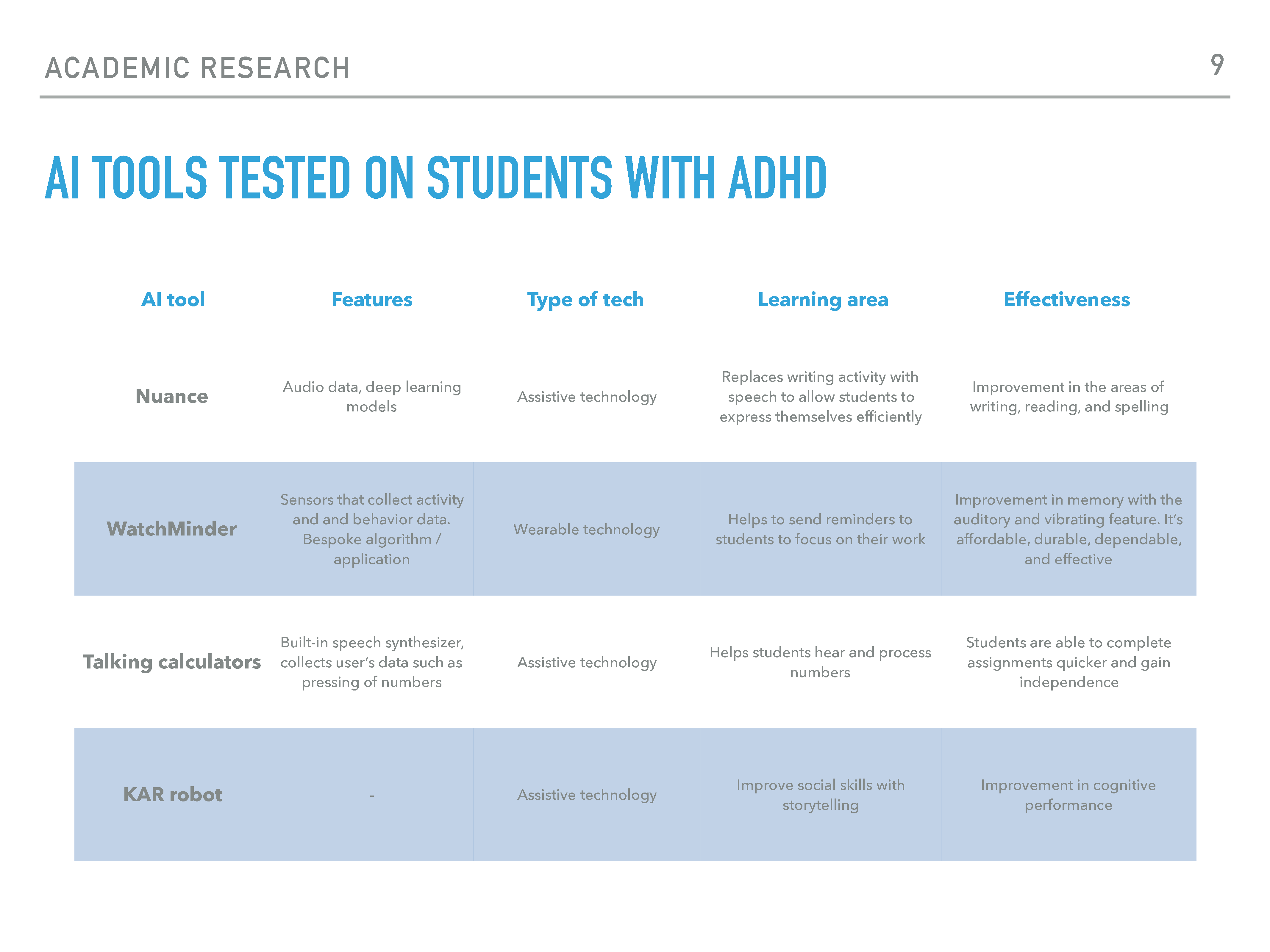
  • Most AI tools have shown positive outcomes in educational learning​

  • Most robots and application-based tools have helped those with autism in their learning

  • A study shows that robots help those with autism improve their social communication skills and daily living skills

  • Most application-based tools have helped those with dyslexia in their learning

  • Application-based tools, wearable devices, and robots have all mildly helped students with ADHD

  • Most AI tools have shown positive outcomes in educational learning​

  • Most robots and application-based tools have helped those with autism in their learning

  • A study shows that robots help those with autism improve their social communication skills and daily living skills

  • Most application-based tools have helped those with dyslexia in their learning

  • Application-based tools, wearable devices, and robots have all mildly helped students with ADHD

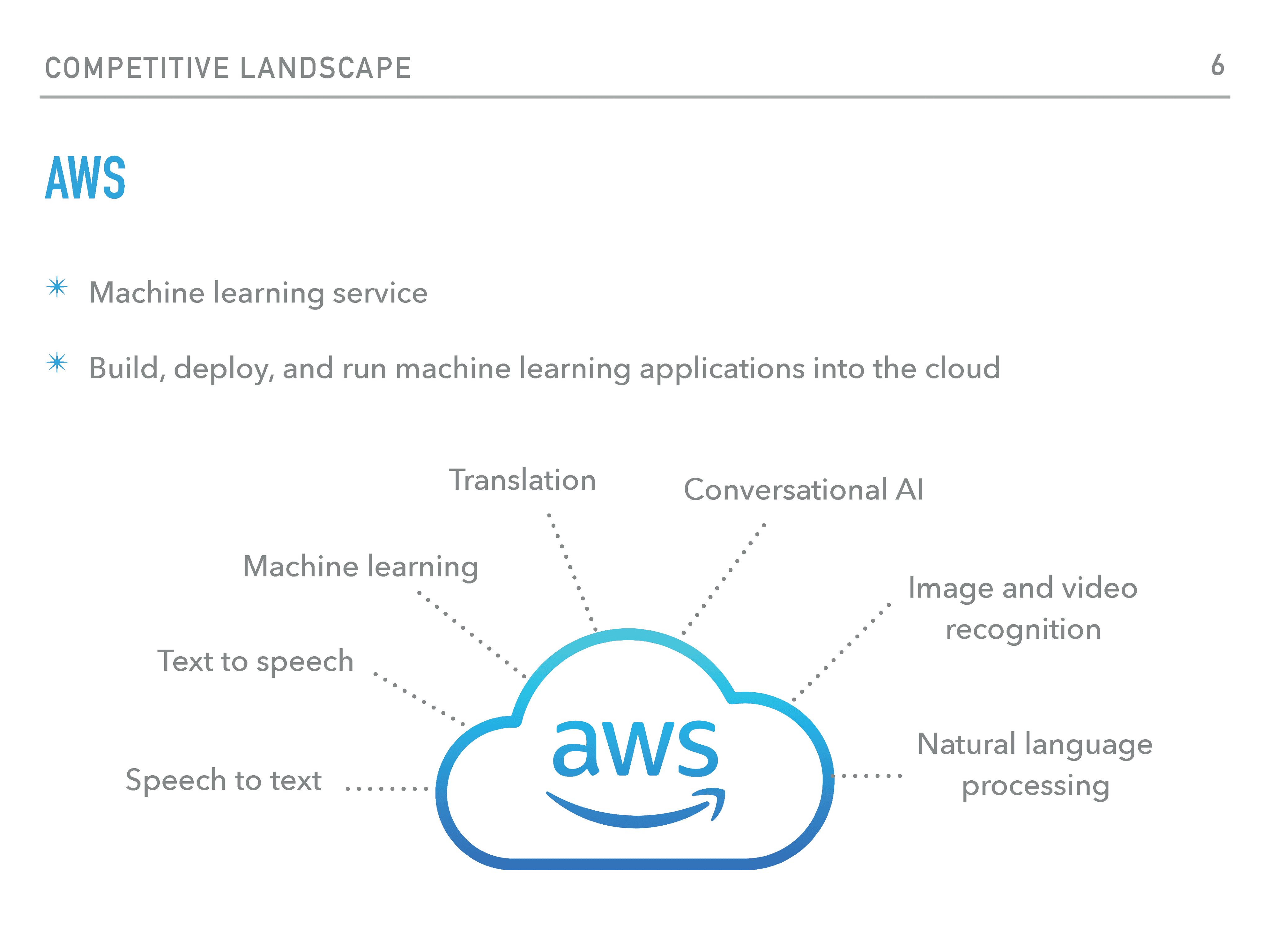
​​Cloud-based applications allow users to input their data such as clinical information, genetic history, speech signals, and facial expression images, which will be then sent to deep learning and analysis models held in the cloud server.

​​Cloud-based applications allow users to input their data such as clinical information, genetic history, speech signals, and facial expression images, which will be then sent to deep learning and analysis models held in the cloud server.

4

Opportunity Analysis

The opportunity analysis is a formal milestone to present my research findings and possible opportunities and directions I will take on my thesis project. In my opportunity analysis, I present the following:

  • Overview of the topic

  • Academic research

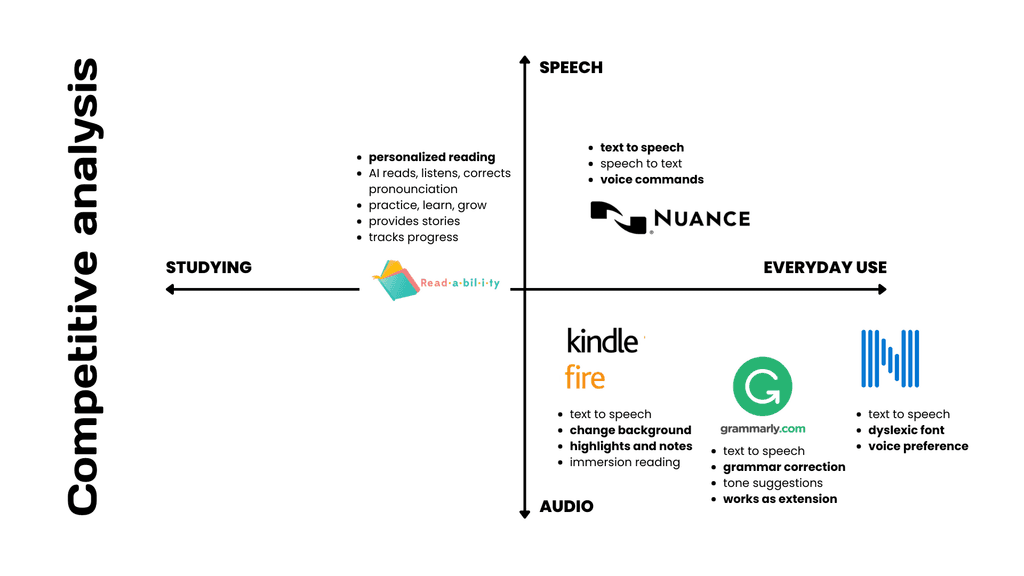
  • Competitive landscape

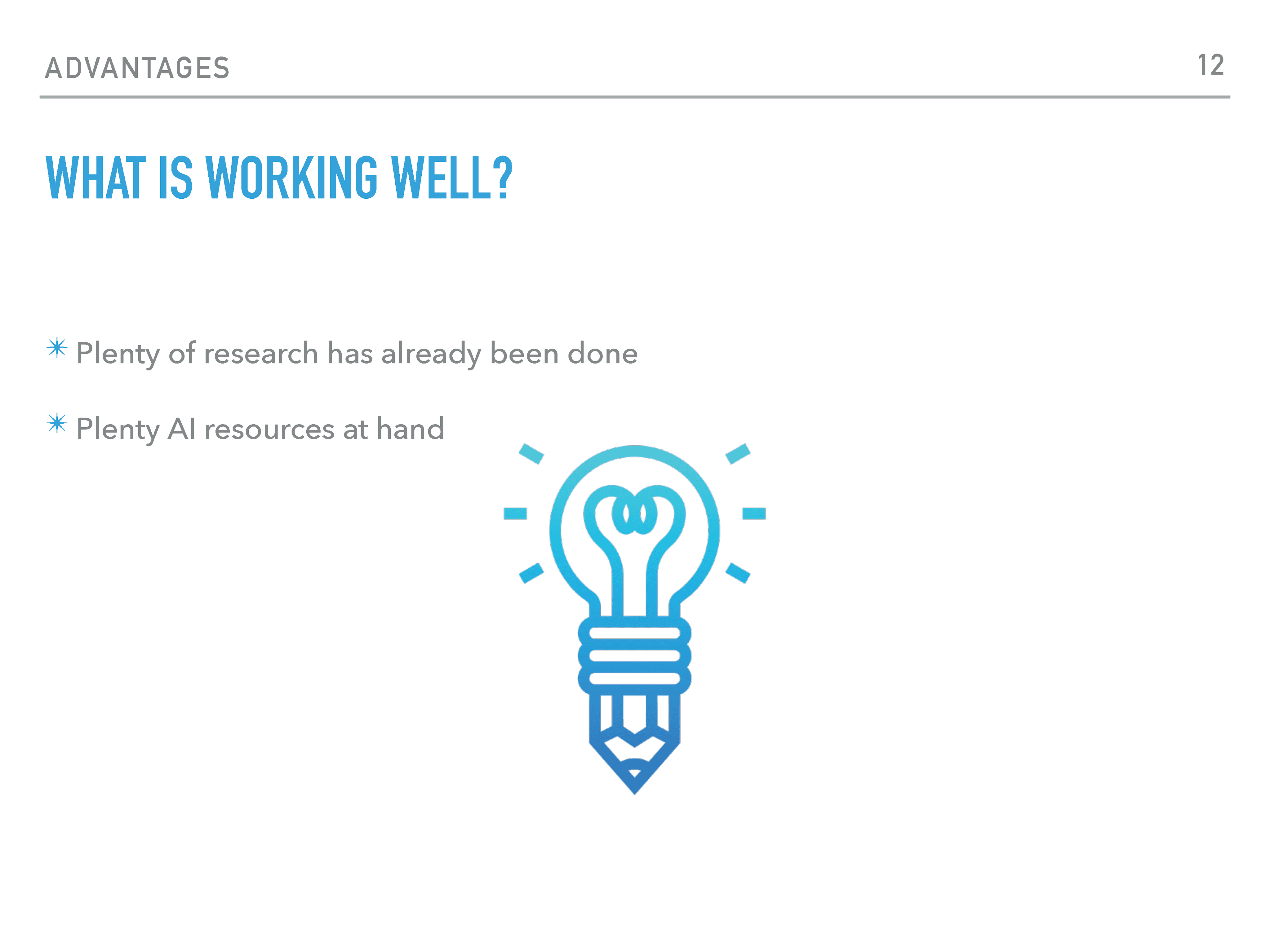
  • What is working well?

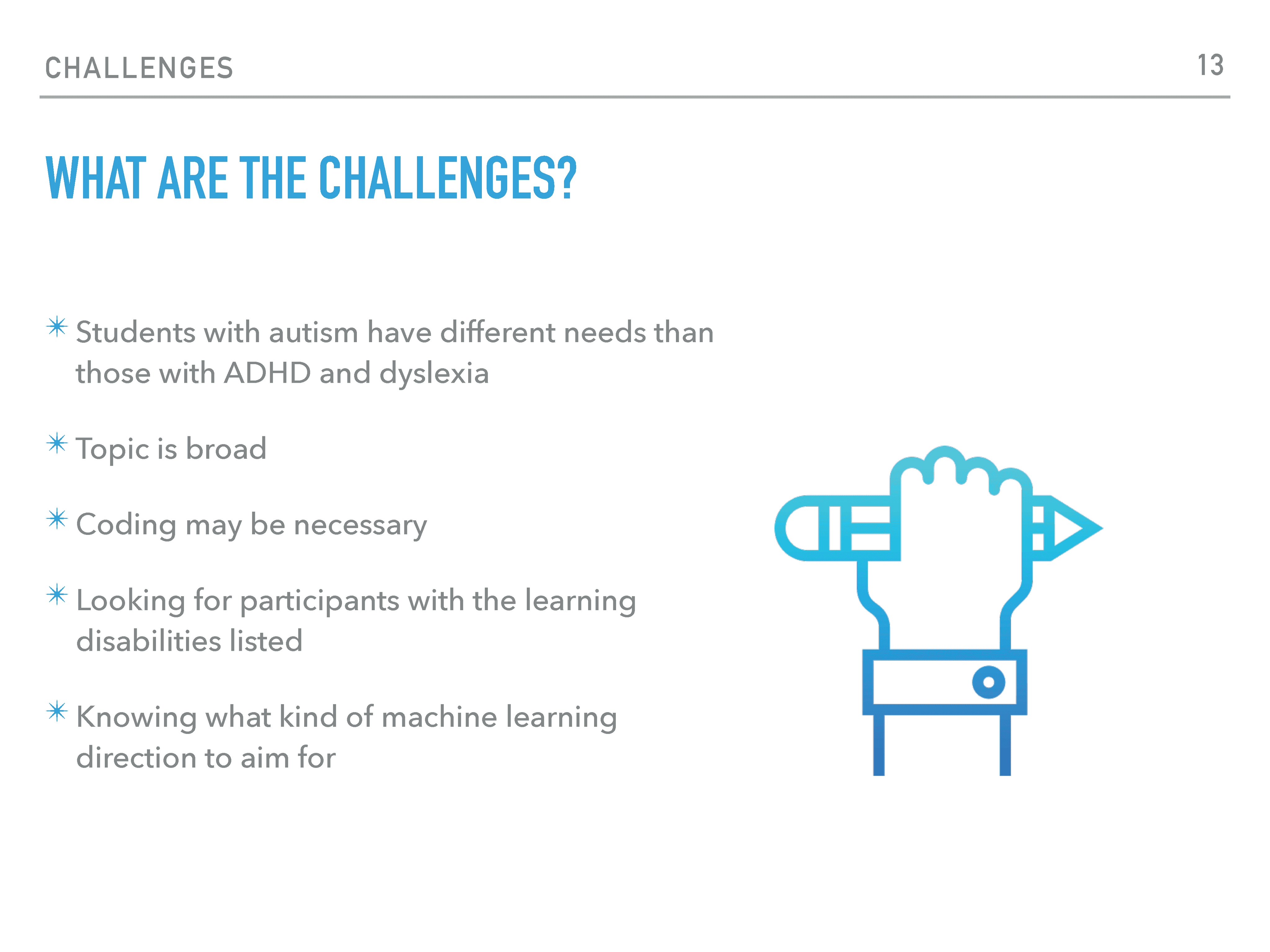
  • What are the challenges?

  • Target audience

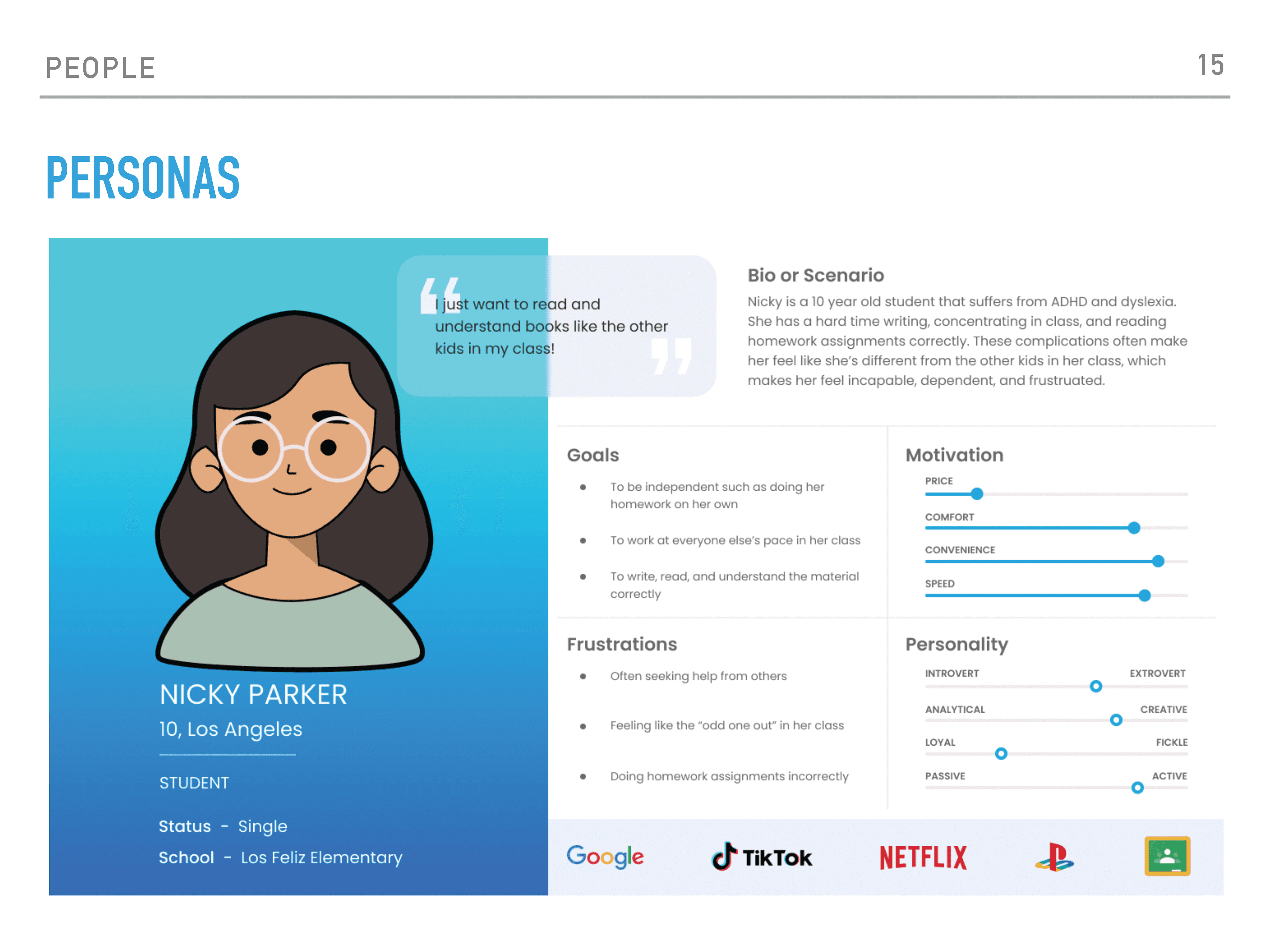
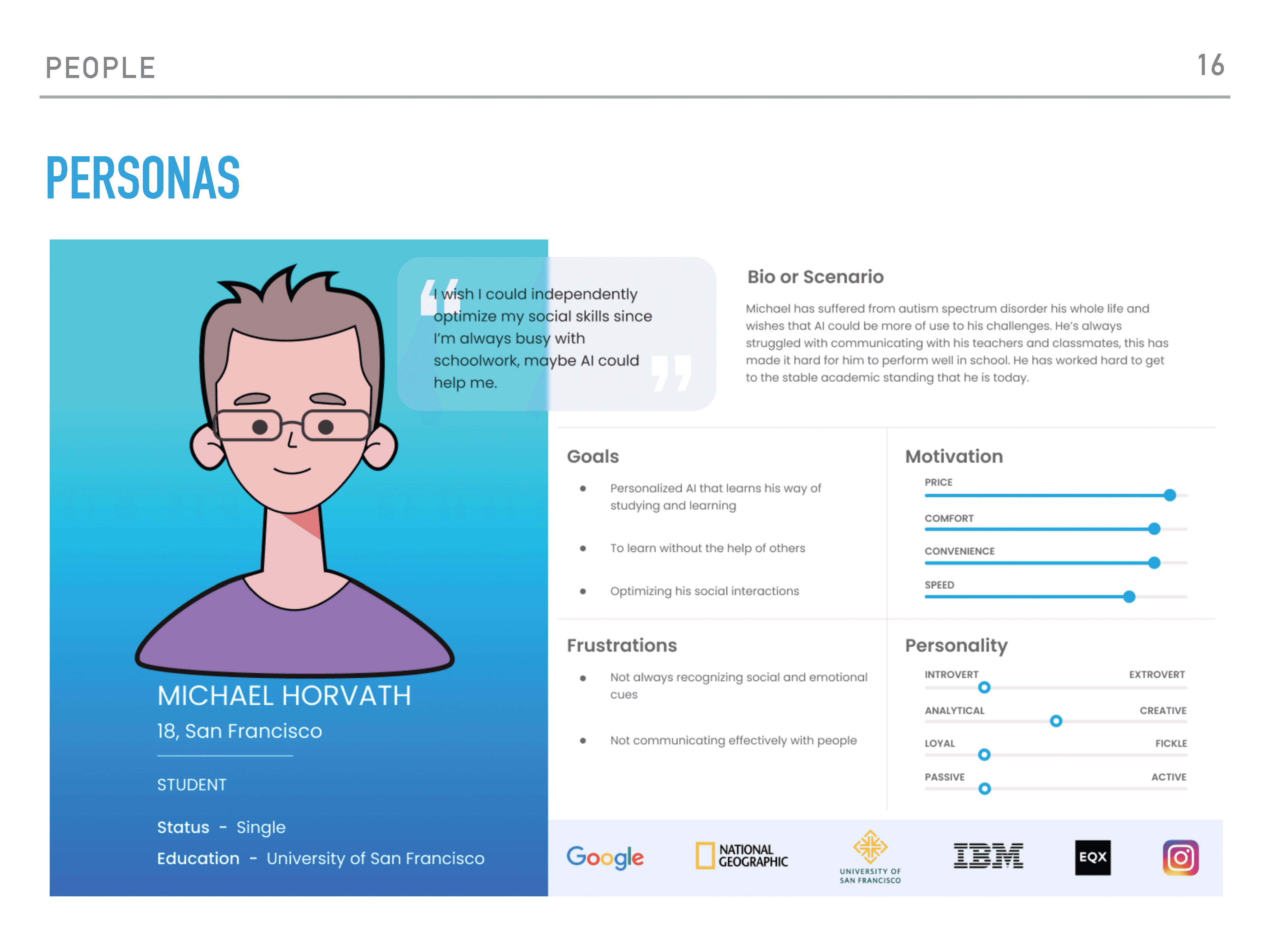
  • Personas

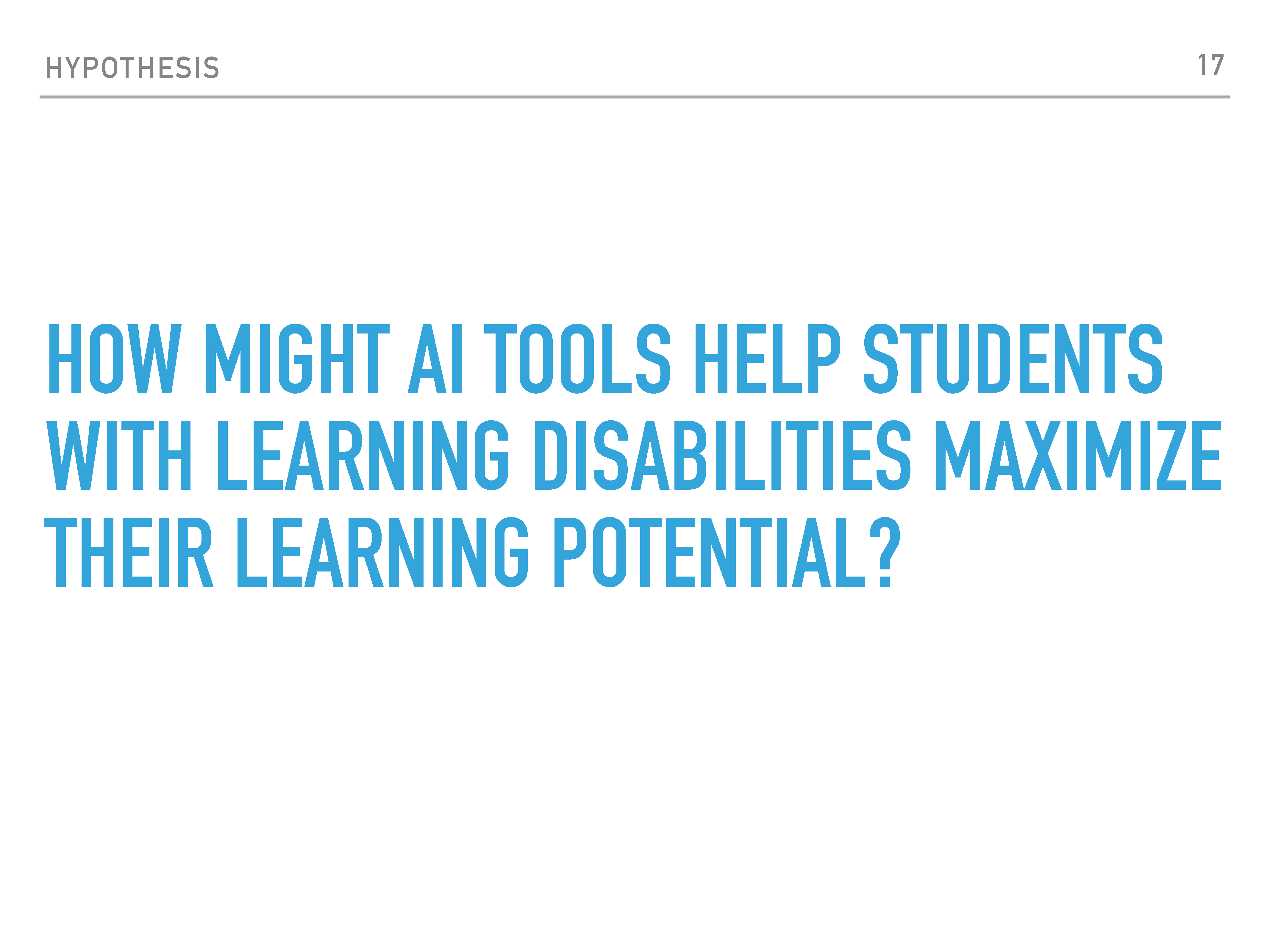
  • Hypothesis

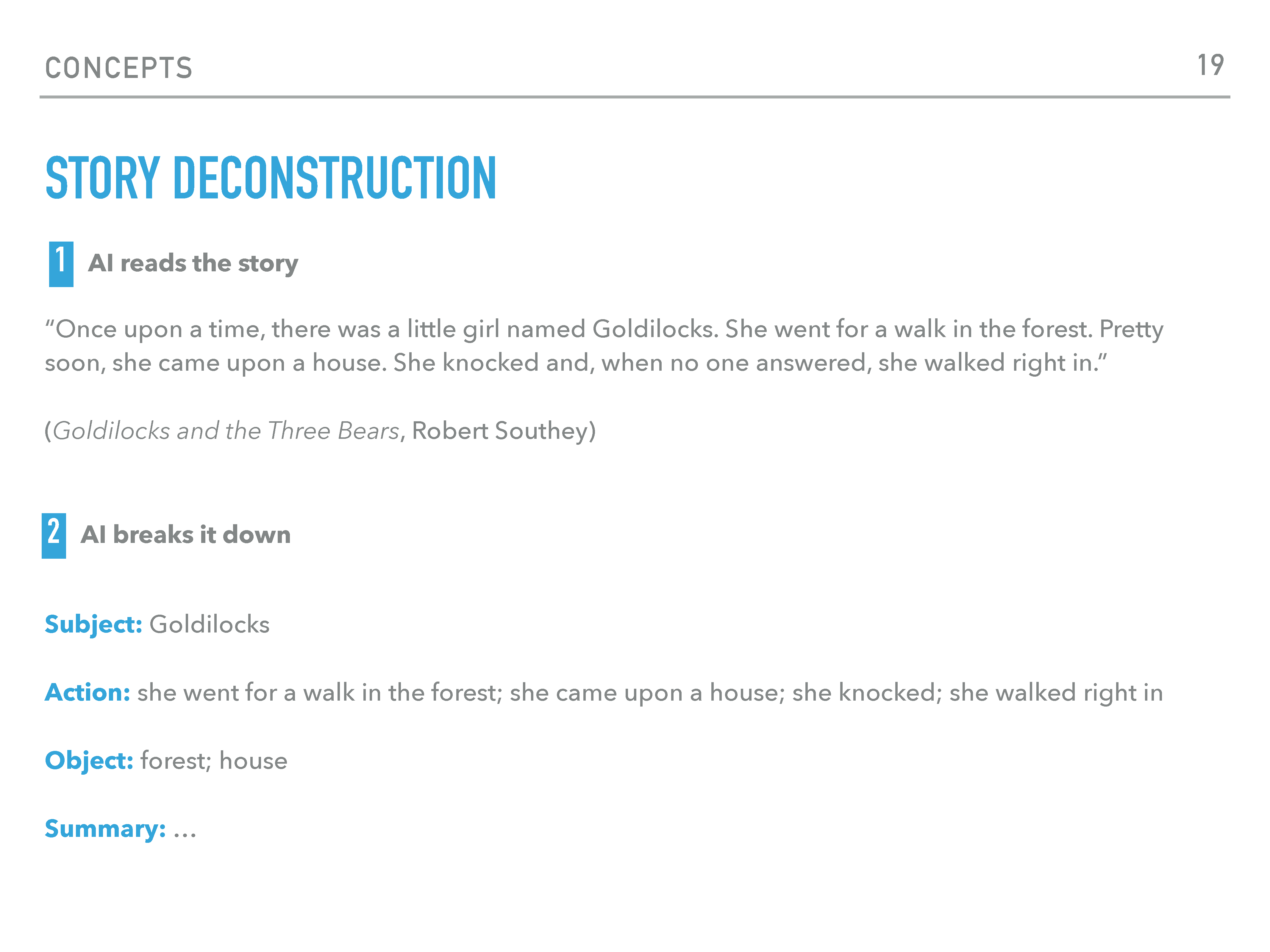
  • Concepts

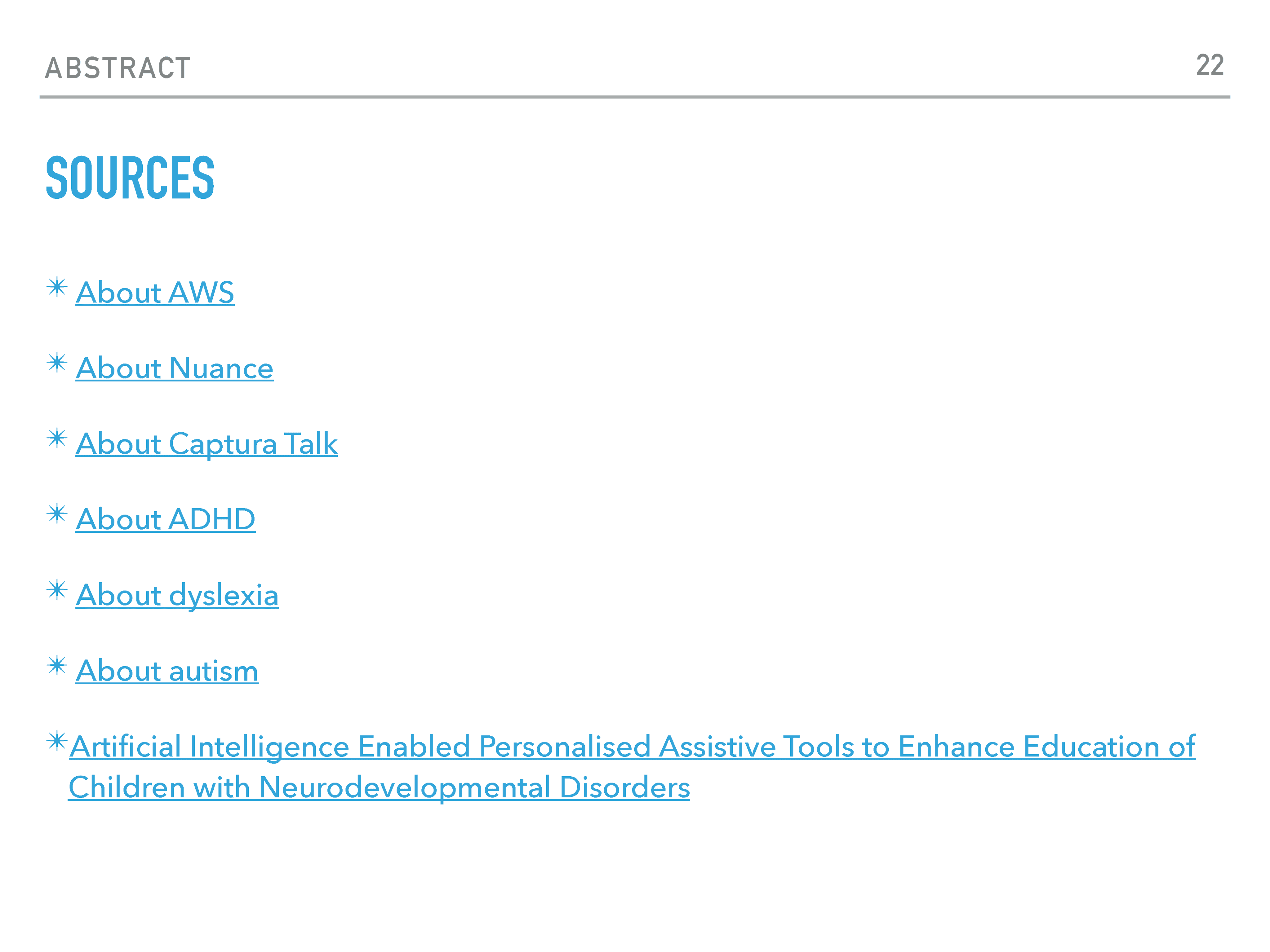
  • Sources

The opportunity analysis is a formal milestone to present my research findings and possible opportunities and directions I will take on my thesis project. In my opportunity analysis, I present the following:

  • Overview of the topic

  • Academic research

  • Competitive landscape

  • What is working well?

  • What are the challenges?

  • Target audience

  • Personas

  • Hypothesis

  • Concepts

  • Sources

Based on the feedback I received in class, the target audience was too broad so it was best that I focused on only one learning disability which is dyslexia. According to my research, personalized learning tools showed a positive learning outcome for those with dyslexia. With limited personalized tools in the market and a lack of experience in cloud computing, I decided to shift to other AI tools that would mainly focus on helping with reading and comprehension (more on this in the next section). 

Based on the feedback I received in class, the target audience was too broad so it was best that I focused on only one learning disability which is dyslexia. According to my research, personalized learning tools showed a positive learning outcome for those with dyslexia. With limited personalized tools in the market and a lack of experience in cloud computing, I decided to shift to other AI tools that would mainly focus on helping with reading and comprehension (more on this in the next section). 

5

Style Guide

5

Style Guide

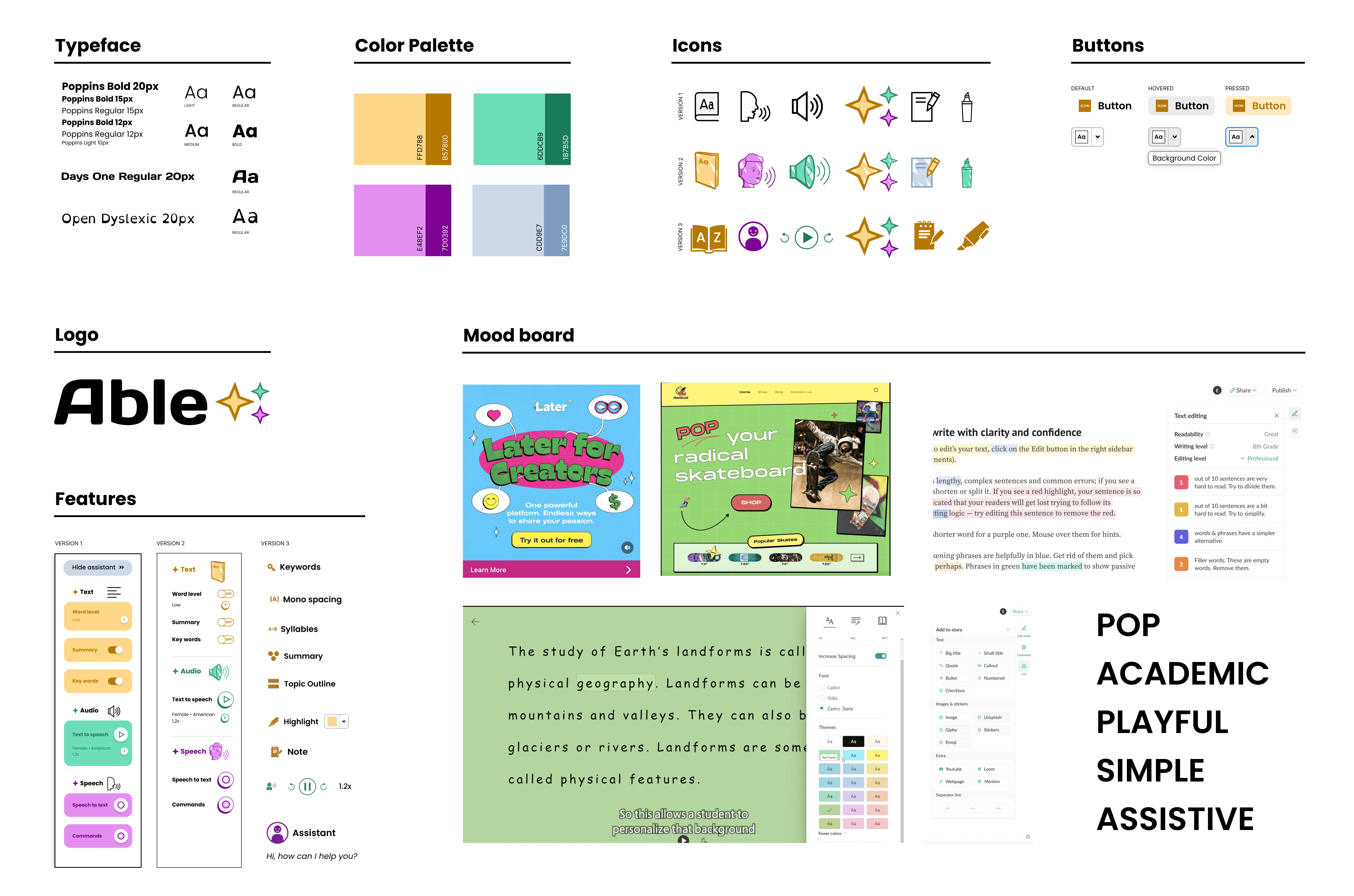
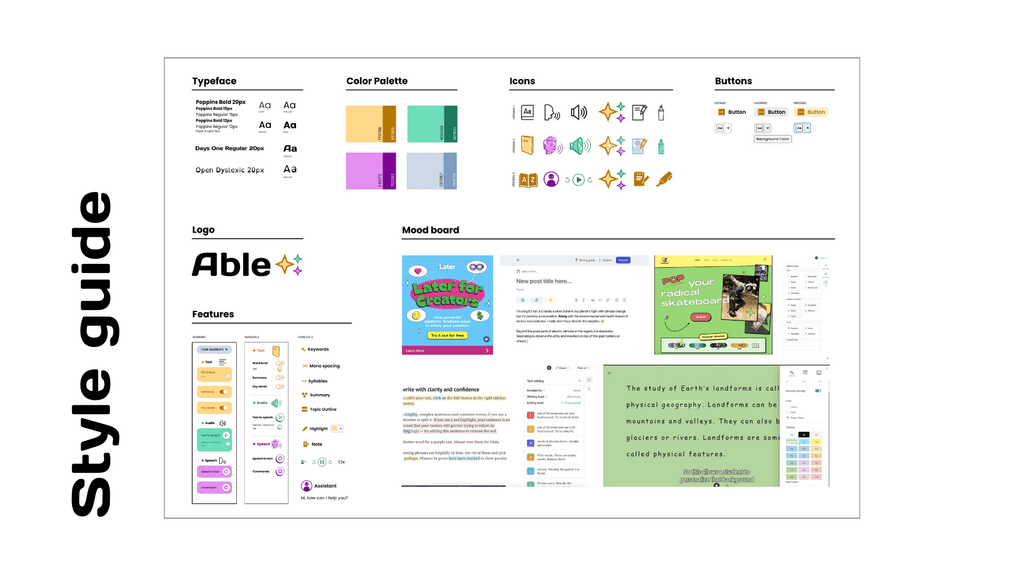
Color palette

My inspiration for the color palette was an old school chalkboard, where the surface is green and the boarder is dark yellow, or 'wood' colored. I chose pink and blue to contrast the green and yellow.

My inspiration for the color palette was an old school chalkboard, where the surface is green and the boarder is dark yellow, or 'wood' colored. I chose pink and blue to contrast the green and yellow.

Logo

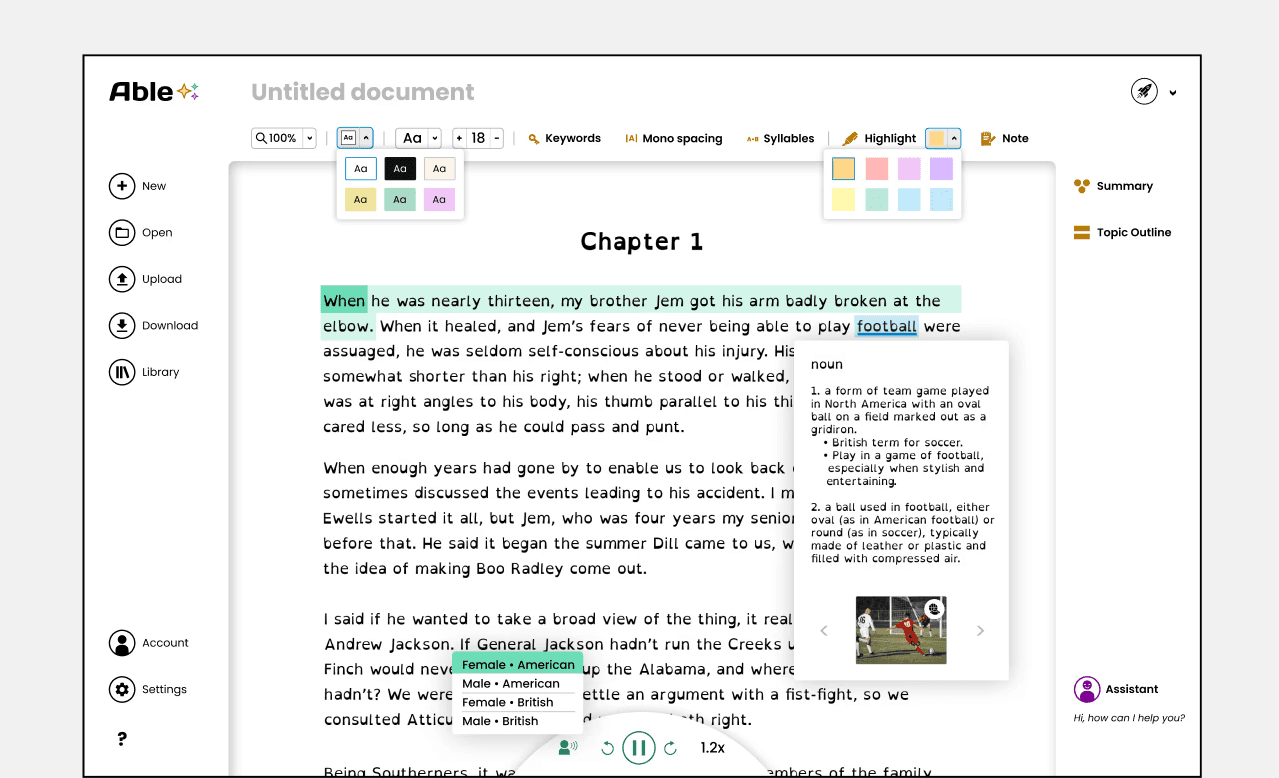
I chose to name my product "Able" so that users can feel encouraged and able to do their work and so they could also remember that Able is here to assist.

I chose to name my product "Able" so that users can feel encouraged and able to do their work and so they could also remember that Able is here to assist.

Typeface

The default font for Able is "OpenDyslexic", a font that more digestable for those with dyslexia. Albeit, the font can be easily changed to the users' preference.

The default font for Able is "OpenDyslexic", a font that more digestable for those with dyslexia. Albeit, the font can be easily changed to the users' preference.

Mood

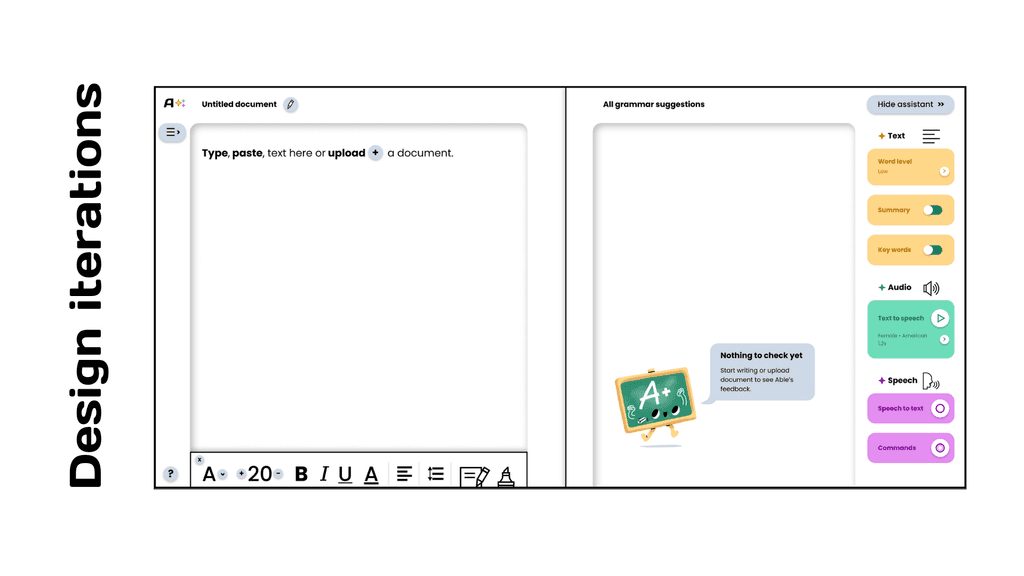
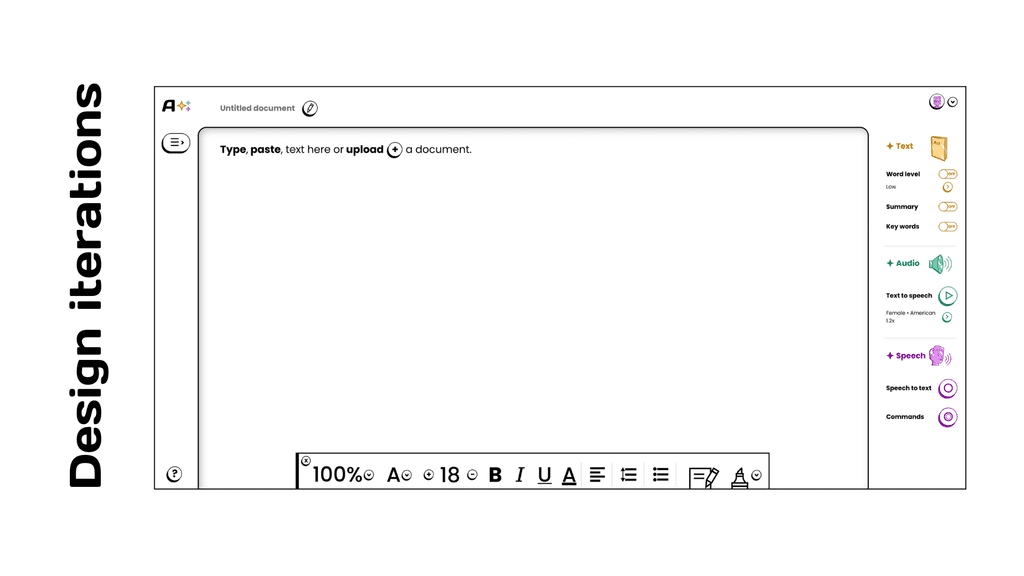
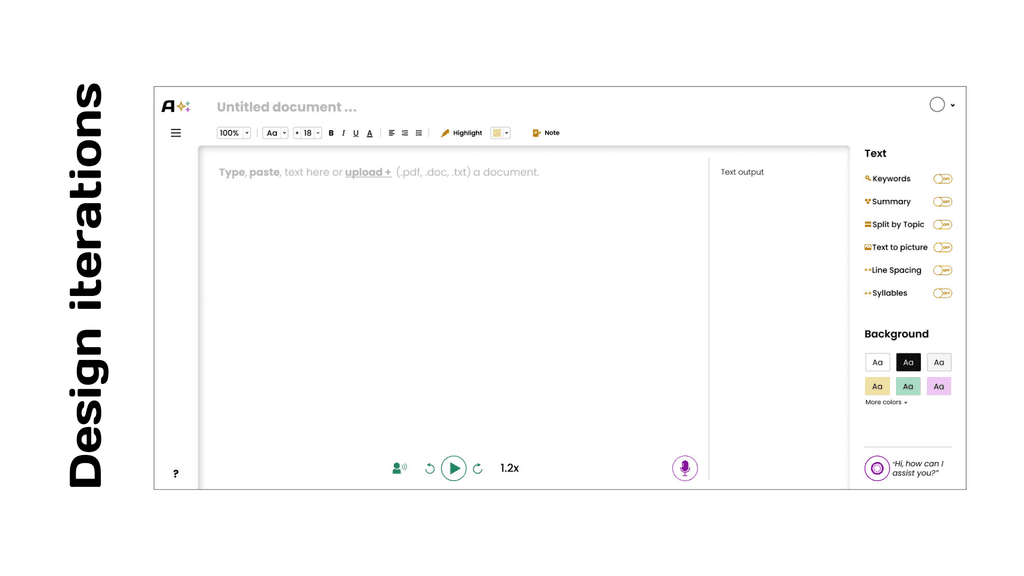
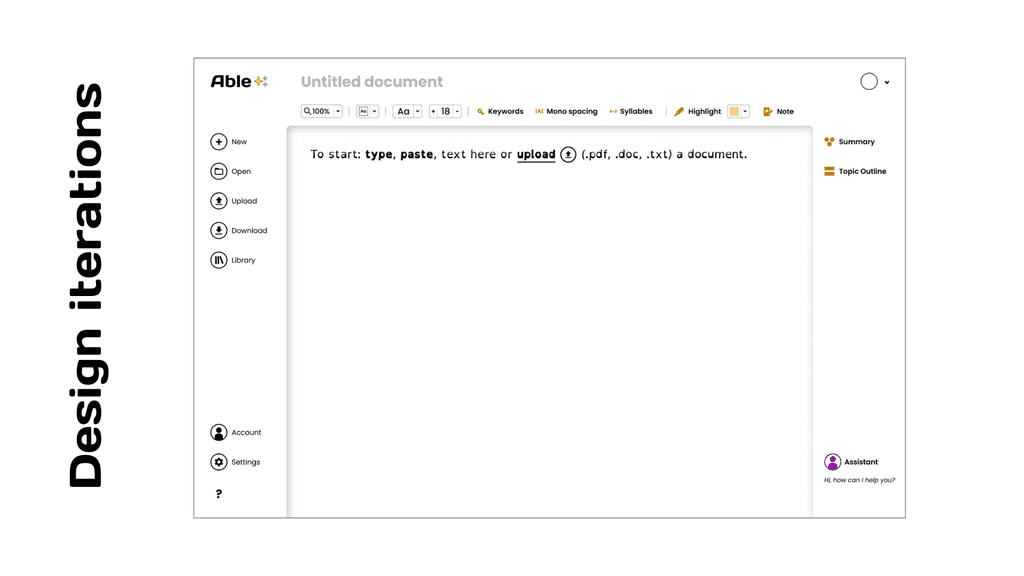
In the beginning phases of designing Able I chose to make interface bubbly so that users wouldn't feel intimidated when they use the product. The downside was that it was too distracting, so I decided to design a more simple interface with a pinch of playfulness.

In the beginning phases of designing Able I chose to make interface bubbly so that users wouldn't feel intimidated when they use the product. The downside was that it was too distracting, so I decided to design a more simple interface with a pinch of playfulness.

6

User Testing

6

User Testing

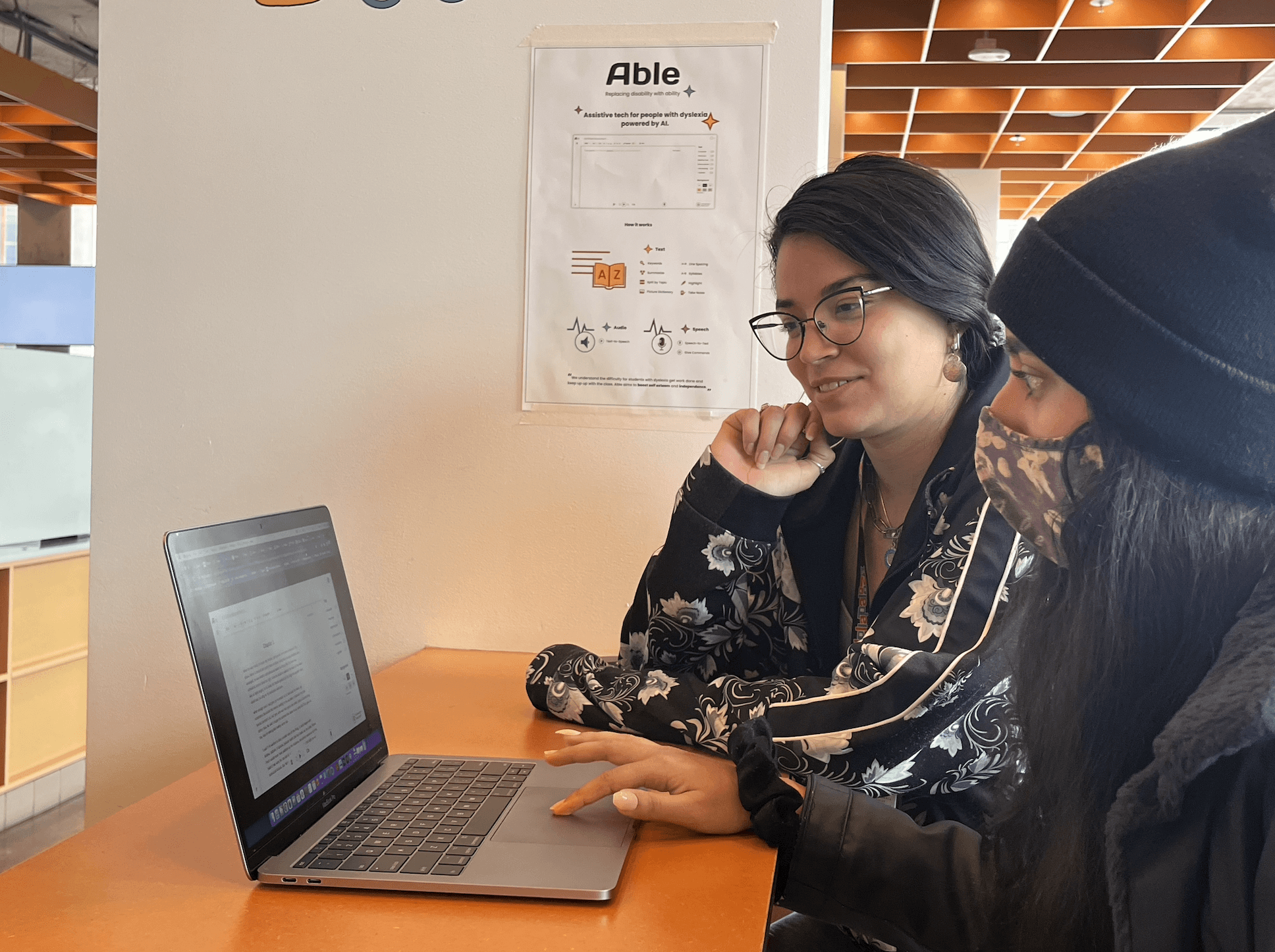
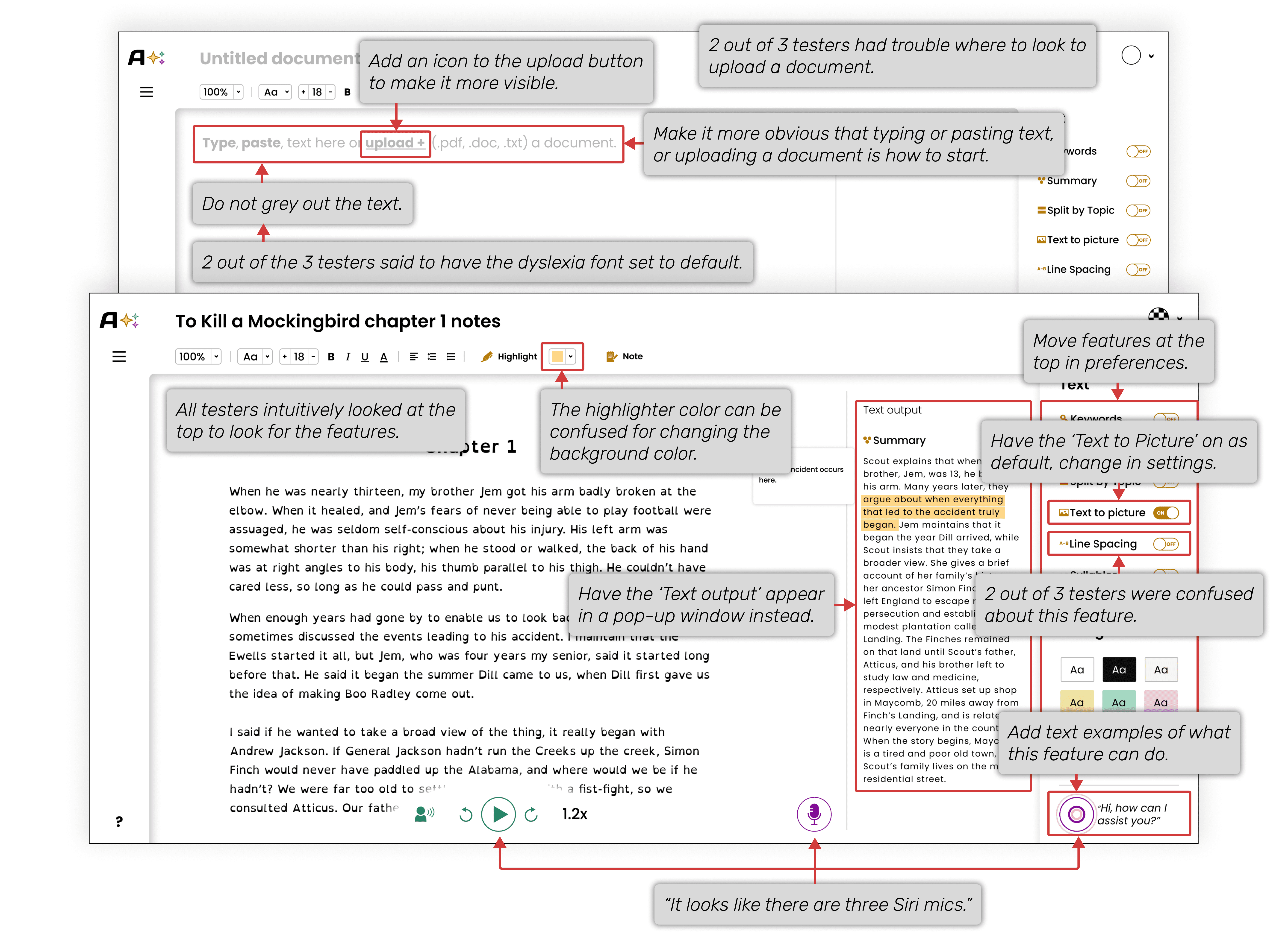
User testing is one of the most crucial steps to creating a product for the people. A product that has not been tested by its target user cannot improve itself. After carefully researching user needs, preferences, and pain points, it is now time to gather insights on real people. In this section of the project, I tested my product on three individuals. One has dyslexia, one has mild dyslexia, and the third doesn't have dyslexia.

User testing is one of the most crucial steps to creating a product for the people. A product that has not been tested by its target user cannot improve itself. After carefully researching user needs, preferences, and pain points, it is now time to gather insights on real people. In this section of the project, I tested my product on three individuals. One has dyslexia, one has mild dyslexia, and the third doesn't have dyslexia.

Users

Users

Anne

Anne

Is mildly dyslexic

Is mildly dyslexic

Auggie

Auggie

Dyslexic

Dyslexic

Lee

Lee

Is not dyslexic

Is not dyslexic

Tasks

Tasks

1)

Upload a document.

1)

Upload a document.

1)

Upload a document.

2)

Change the color of the background.

2)

Change the color of the background.

2)

Change the color of the background.

3)

Activate keywords, line spacing, and syllables. Now turn them off.

3)

Activate keywords, line spacing, and syllables. Now turn them off.

3)

Activate keywords, line spacing, and syllables. Now turn them off.

4)

Activate text to speech + adjust the speed and of the voice.

4)

Activate text to speech + adjust the speed and of the voice.

4)

Activate text to speech + adjust the speed and of the voice.

5)

Activate the "text to picture" feature. Double-click on a word to look at the definition.

5)

Activate the "text to picture" feature. Double-click on a word to look at the definition.

5)

Activate the "text to picture" feature. Double-click on a word to look at the definition.

6)

Activate the summary and topic outline.

6)

Activate the summary and topic outline.

6)

Activate the summary and topic outline.

7)

Locate the highlighter, change the color, and highlight something.

7)

Locate the highlighter, change the color, and highlight something.

7)

Locate the highlighter, change the color, and highlight something.

8)

Leave a note somewhere.

8)

Leave a note somewhere.

8)

Leave a note somewhere.

9)

Rename the document with the help of your assistant.

9)

Rename the document with the help of your assistant.

9)

Rename the document with the help of your assistant.

10)

Save the document.

10)

Save the document.

10)

Save the document.

Feedback

Feedback

Changes

Changes

8

Final Presentation

8

Final Presentation

8

Final Presentation

Sources

Reflections

Reflections

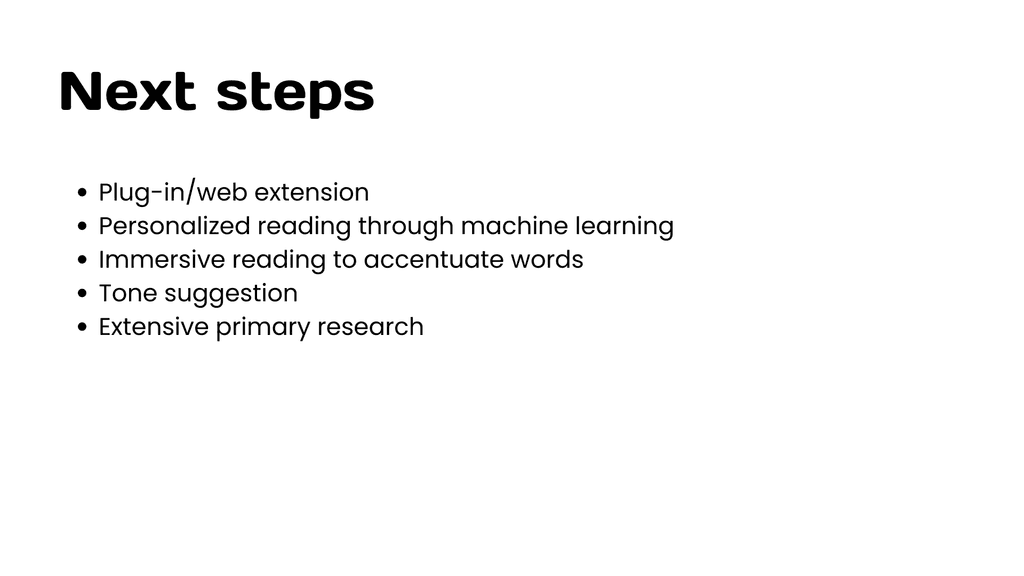
Over the past two years, developing this project came with many challenges, but each obstacle led to a breakthrough. The most difficult part was looking for people for testing and designing the user interface, which underwent multiple redesigns. I’m deeply grateful for the invaluable feedback that shaped its success. This project holds a special place in my heart, as it encapsulates everything I’ve learned during my four years at CCA.
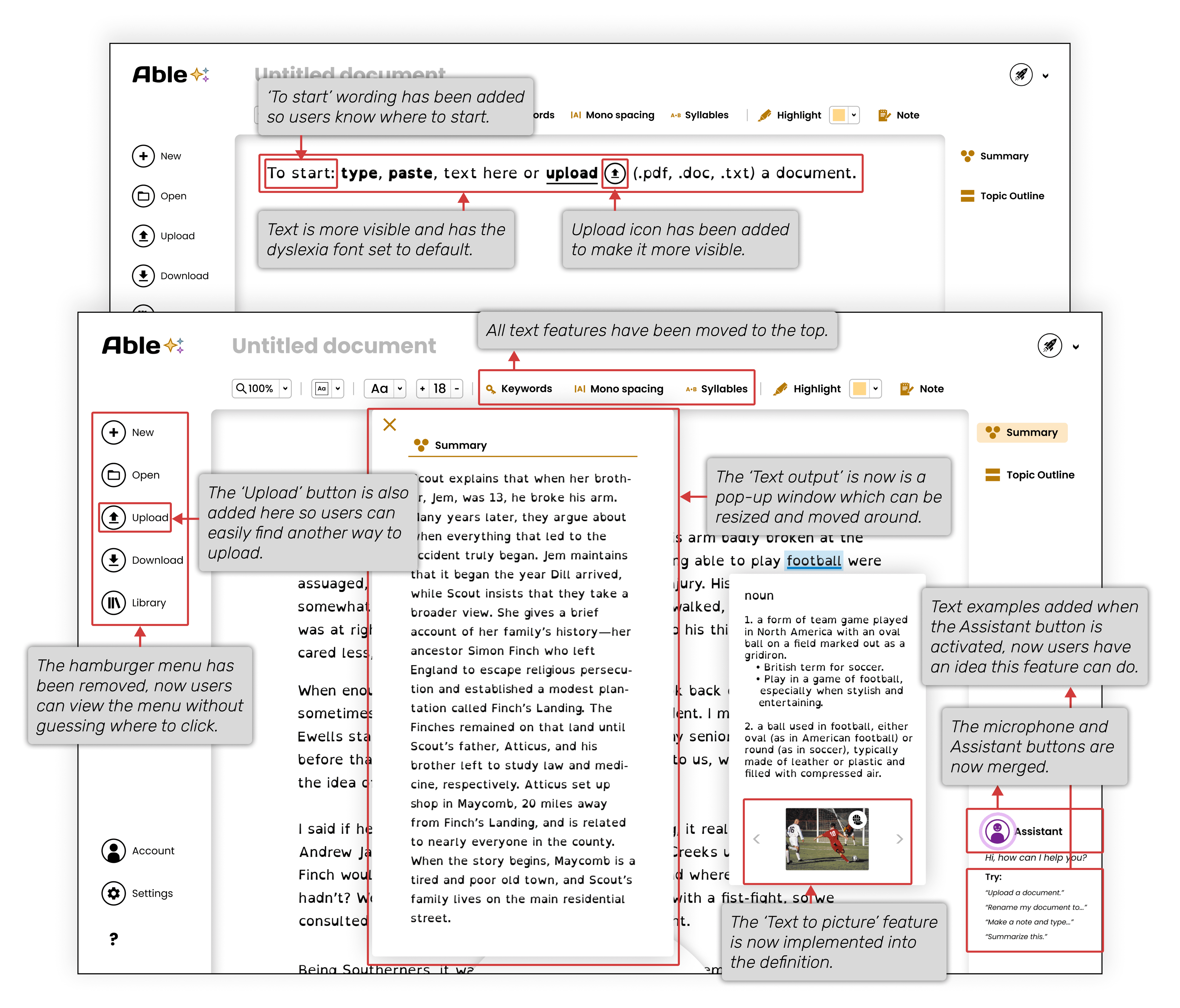
Moving forward, I aim to evolve 'Able' into a web extension rather than a website requiring document uploads. My next steps include integrating personalized reading through machine learning, enhancing immersive reading to emphasize key words, and conducting extensive primary research.

Over the past two years, developing this project came with many challenges, but each obstacle led to a breakthrough. The most difficult part was looking for people for testing and designing the user interface, which underwent multiple redesigns. I’m deeply grateful for the invaluable feedback that shaped its success. This project holds a special place in my heart, as it encapsulates everything I’ve learned during my four years at CCA.

Moving forward, I aim to evolve 'Able' into a web extension rather than a website requiring document uploads. My next steps include integrating personalized reading through machine learning, enhancing immersive reading to emphasize key words, and conducting extensive primary research.

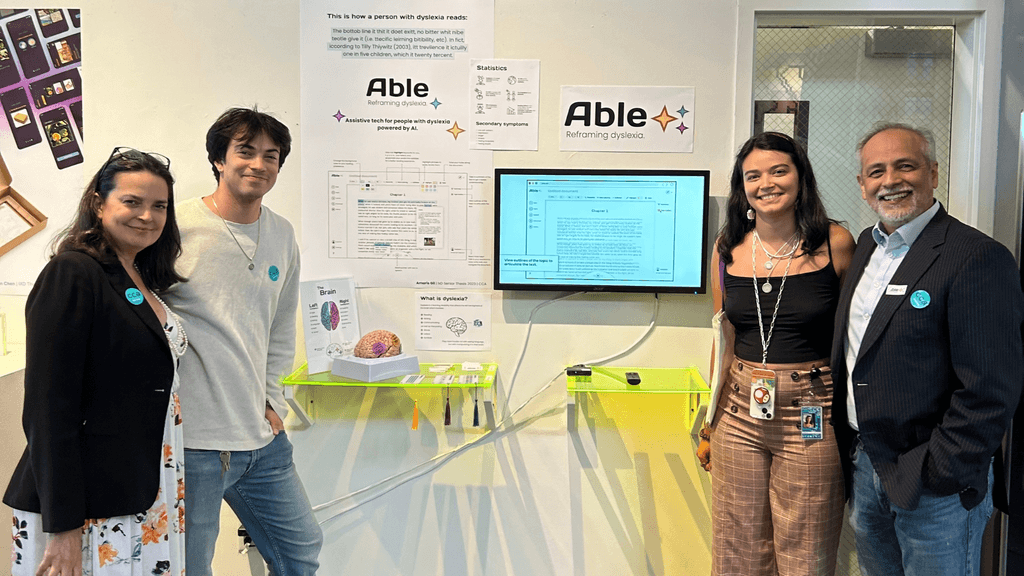
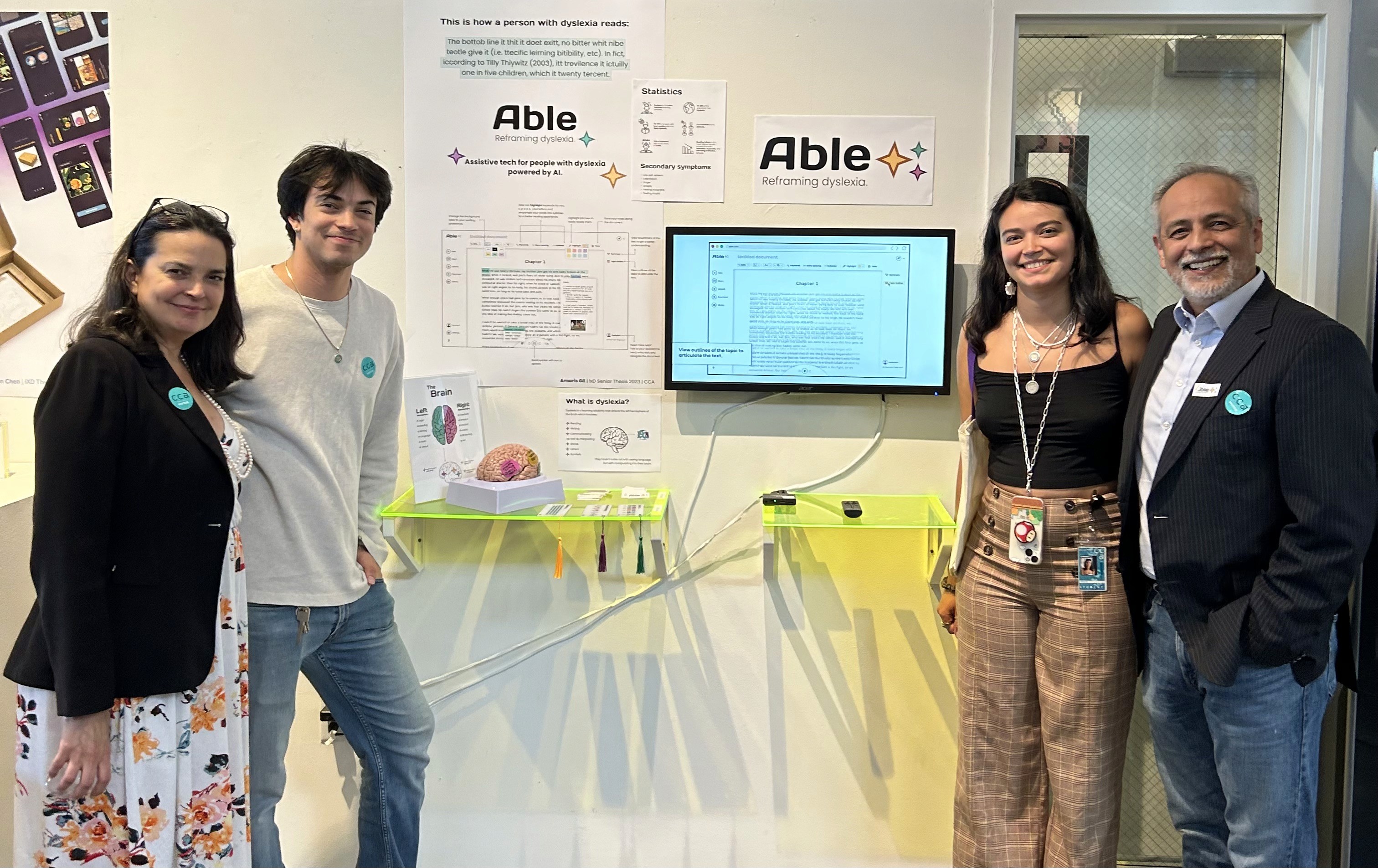
A photo of my family and I at the end of year show.

A photo of my family and I at the end of year show.

©2025 Amaris Gil

©2025 Amaris Gil

Create a free website with Framer, the website builder loved by startups, designers and agencies.